This guide walks you through running KumoRFM inside Snowflake Notebooks. Your data never leaves Snowflake - you connect, build a graph, and make predictions all from within a notebook.
By the end of this guide you will:
- Create a Snowflake Notebook and connect it to a compute pool
- Install the Kumo SDK
- Build a graph from your data (three ways to do this)
- Run prediction queries using KumoRFM
Want to skip ahead? Download the example notebook and import it into Snowflake. It comes pre-filled with all the code from this guide - just update the settings and run the cells. Setup
Follow Steps 1–5 below to set up your notebook. These steps are the same regardless of which data source you use later.
Step 1. Open Snowflake and go to Workspaces
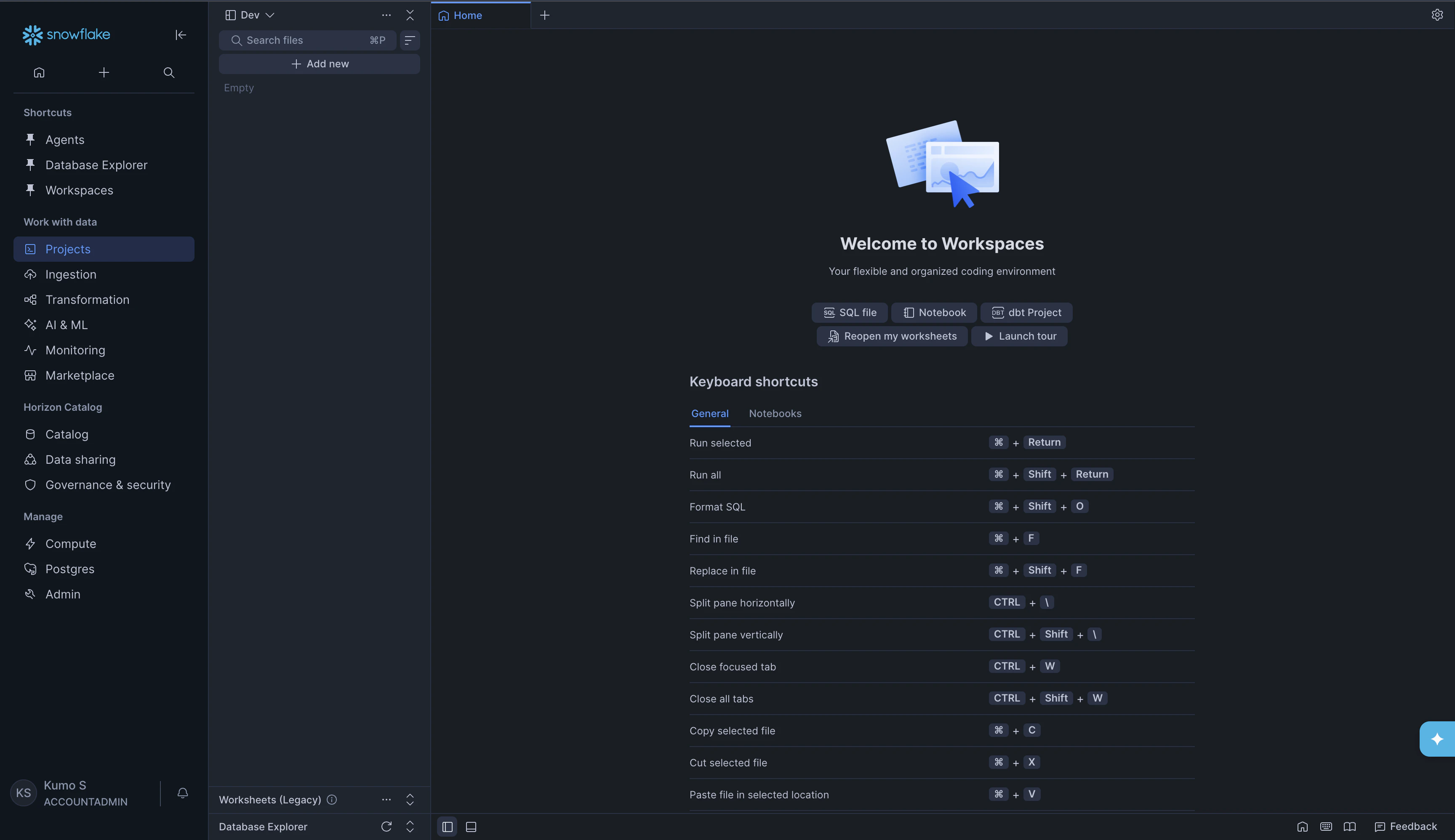
Log in to your Snowflake account. In the left sidebar, click Projects, then click Workspaces.
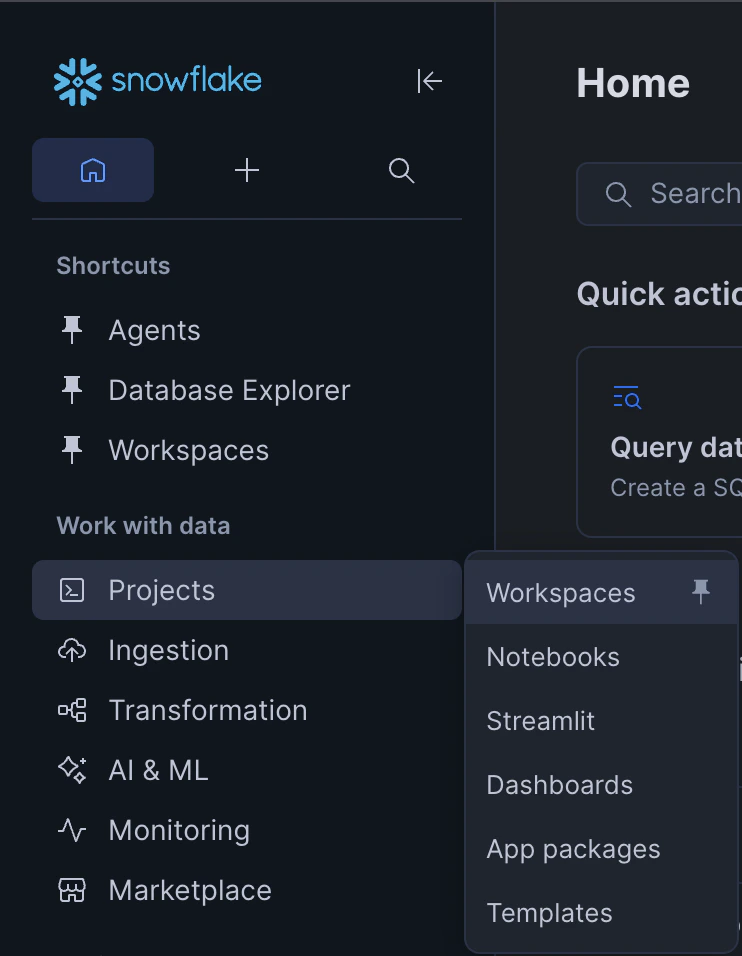 You will see the Welcome to Workspaces page with options to create SQL files, Notebooks, and dbt Projects.
Step 2. Create a new Notebook
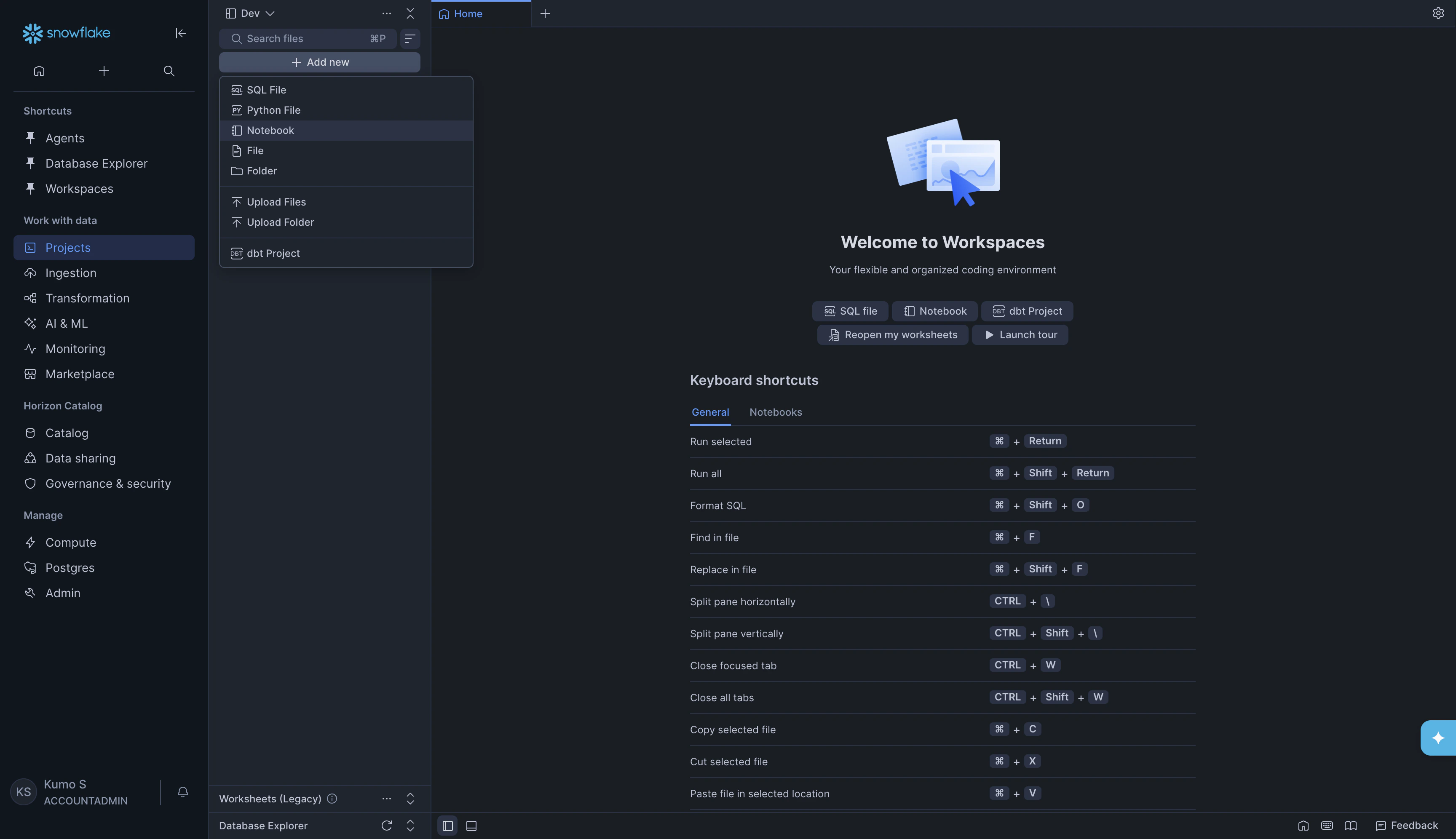
In the left panel, click + Add new. A dropdown menu will appear. Click Notebook.
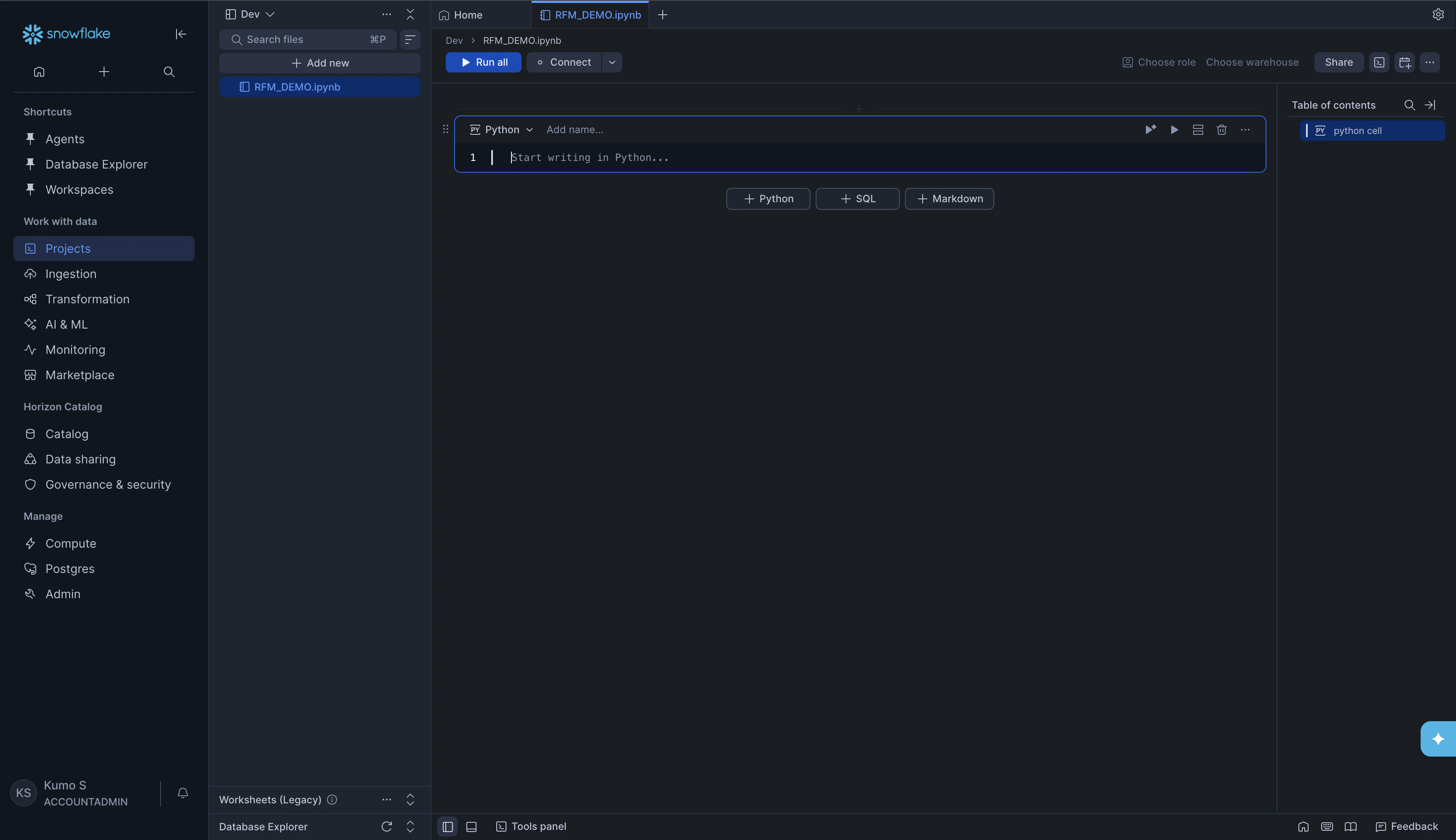
 A new empty notebook will open. You can rename it by clicking the title at the top (for example,
 RFM_DEMO.ipynb).
Step 3. Connect your Notebook
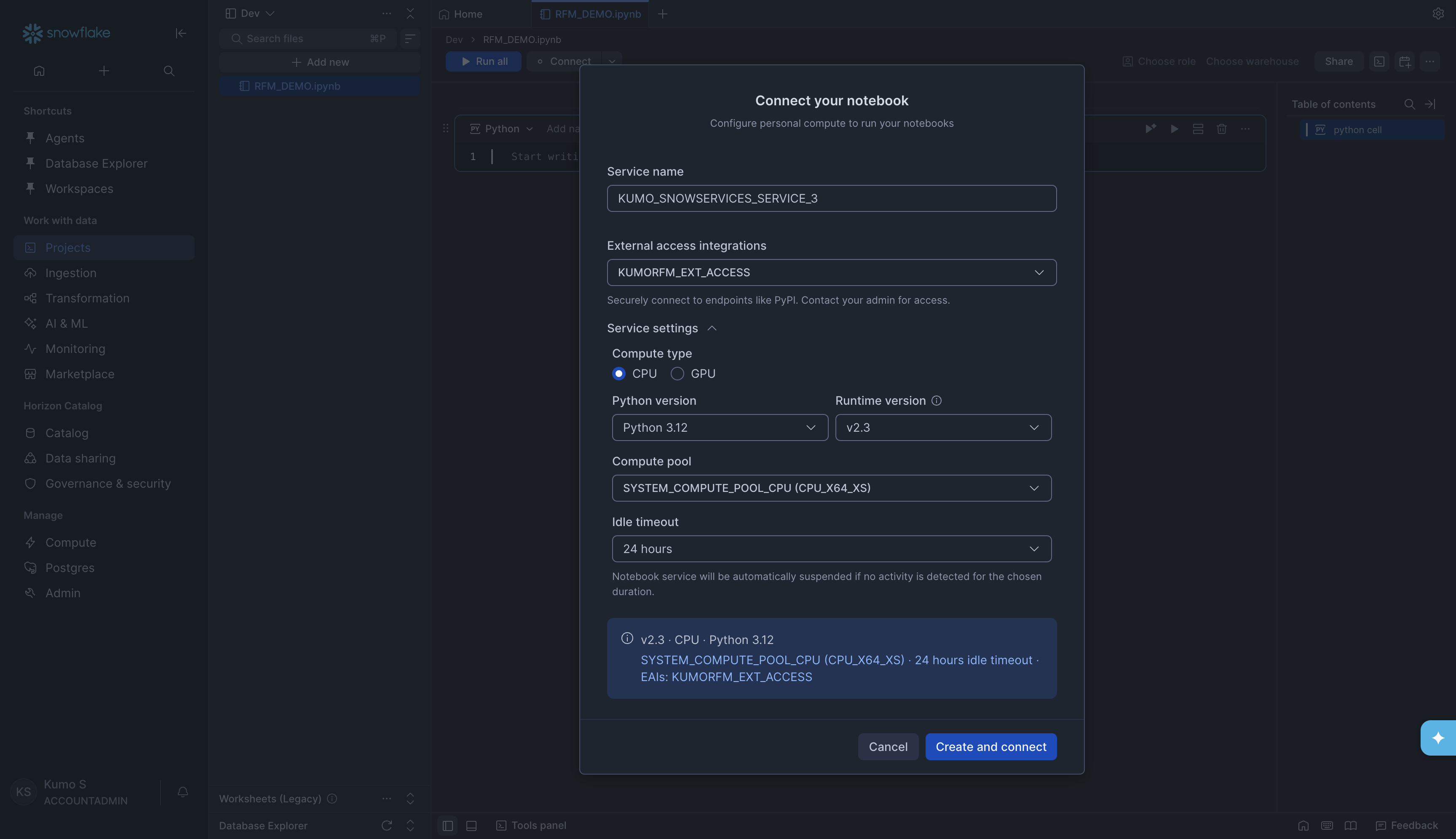
Before you can run any code, you need to connect the notebook to a compute resource. Click the Connect button at the top of the notebook. A dialog called Connect your notebook will appear.
Fill in the following settings:
| Setting | What to enter |
|---|
| Service name | A name for the notebook service (e.g., KUMO_SNOWSERVICES_SERVICE_3) |
| External access integrations | Select an external access integration that has internet access (e.g., one that allows connections to PyPI). This is needed to install packages. Contact your Snowflake admin if you do not have one set up. |
| Compute type | Select CPU |
| Python version | Select Python 3.12 (or the latest available) |
| Runtime version | Select v2.3 (or the latest available) |
| Compute pool | Select SYSTEM_COMPUTE_POOL_CPU (CPU_X64_XS) or another CPU pool available to you |
| Idle timeout | Choose how long the notebook stays running when idle (e.g., 24 hours) |
Step 4. Install the Kumo SDK
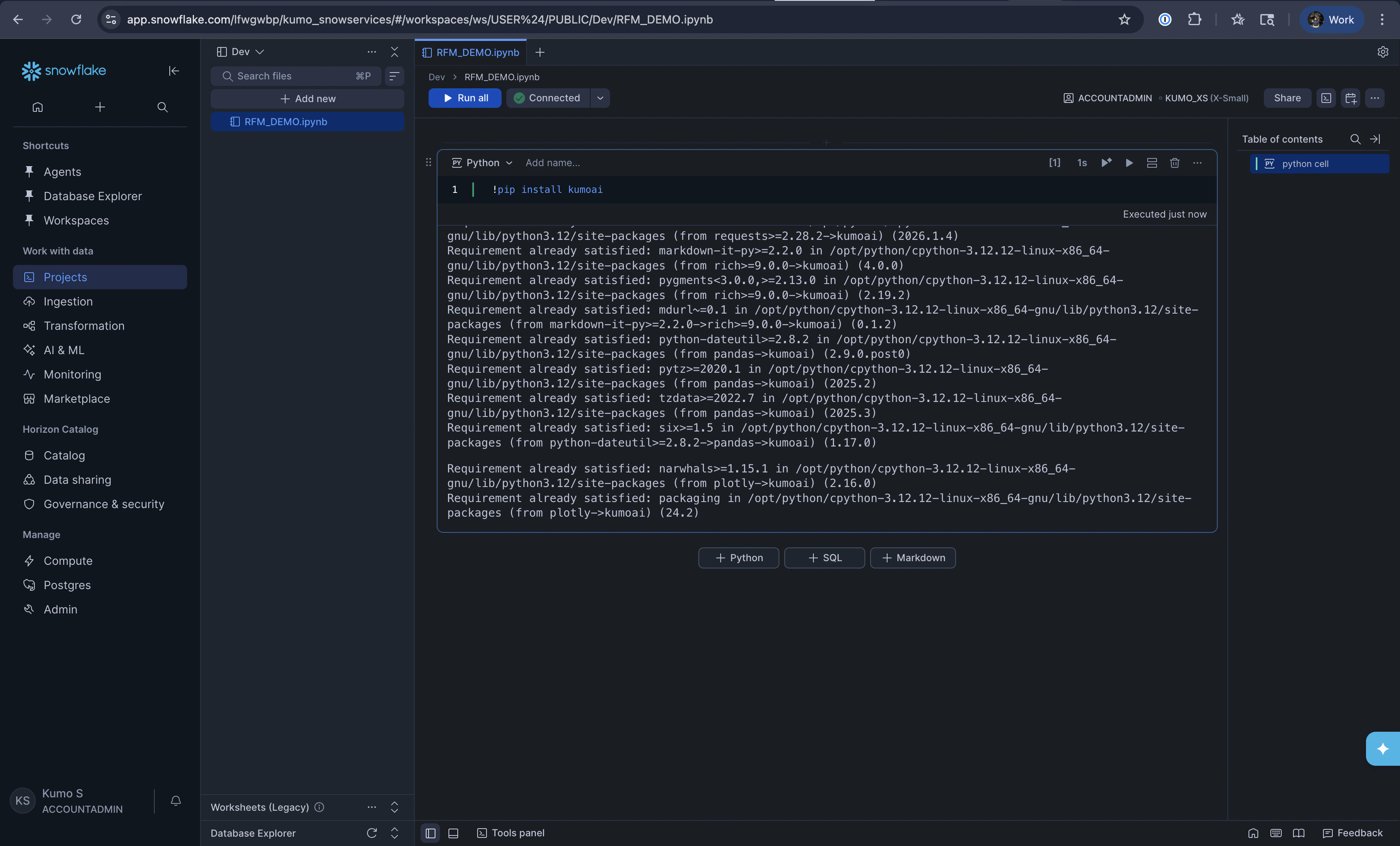
In the first cell of your notebook, install the kumoai package by running:
You will see pip output showing the package being installed along with its dependencies. Once it finishes, you are ready to use KumoRFM.
Step 5. Import and initialize
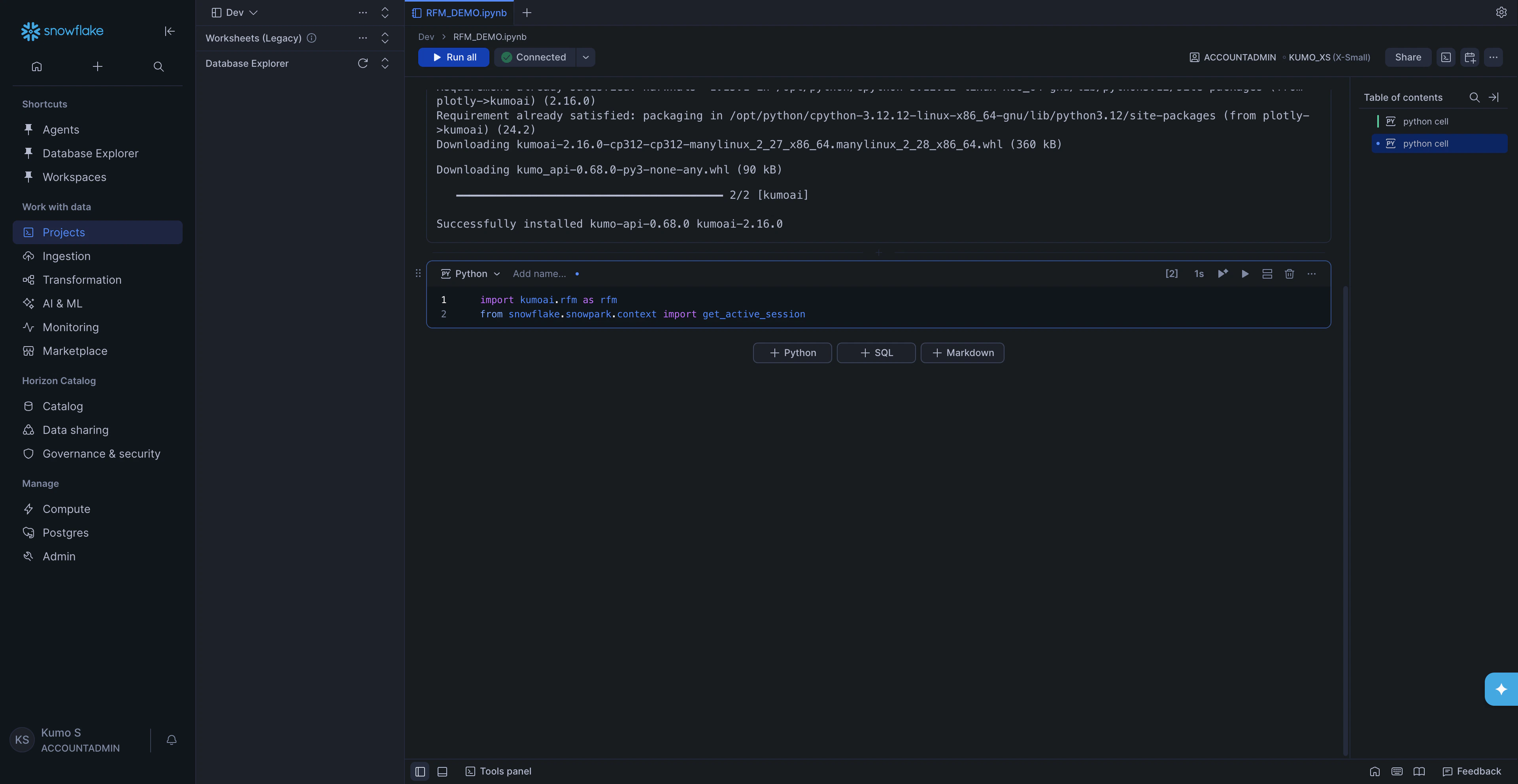
In the next cell, import the required modules:
import kumoai.rfm as rfm
from snowflake.snowpark.context import get_active_session
 In the next cell, get the Snowflake connection and initialize KumoRFM:
connection = get_active_session().connection
rfm.init()
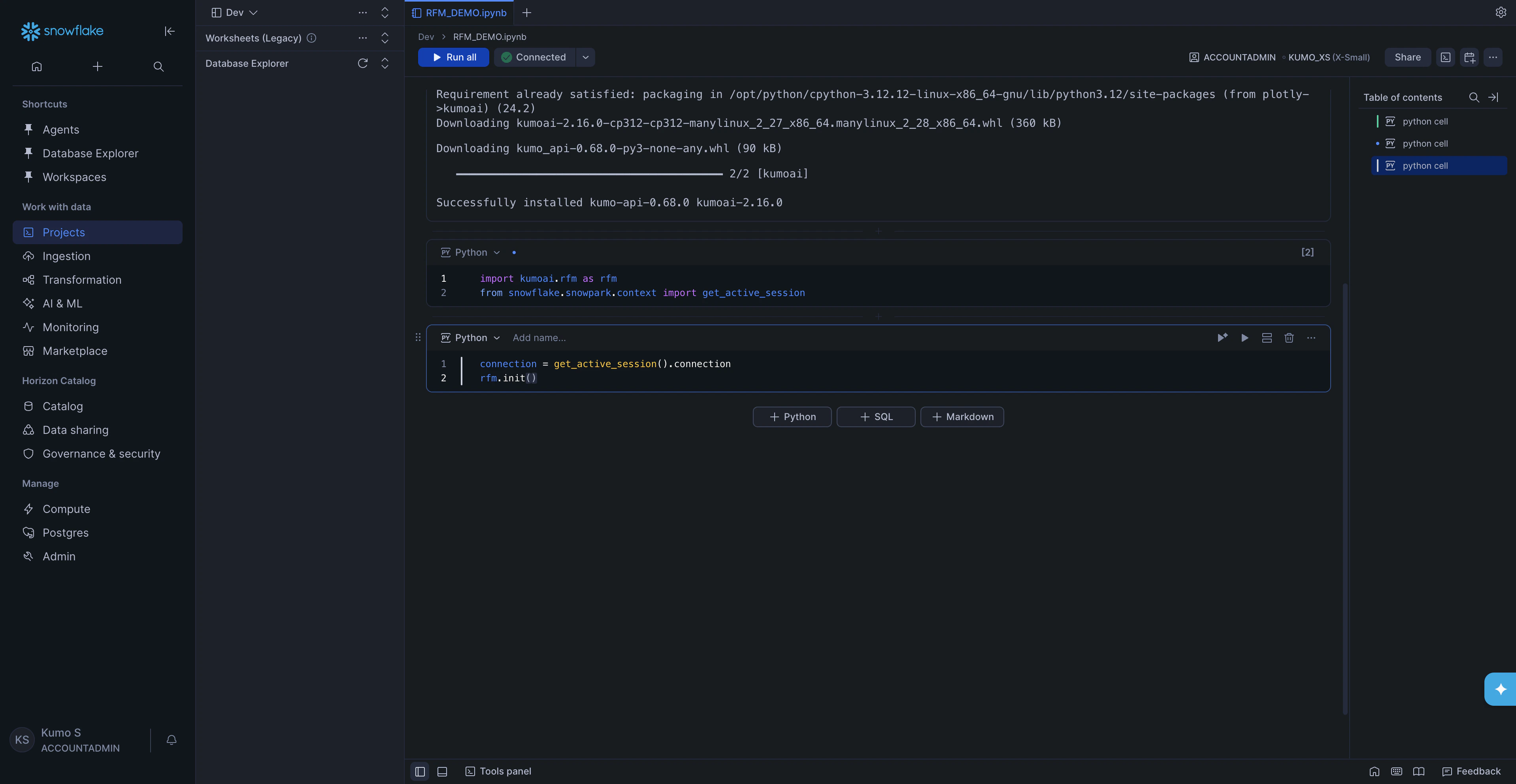 That’s it - KumoRFM is now ready to use. Next, pick one of the three options below to build a graph from your data.
Build Your Graph and Make Predictions
A graph is a description of your data. It defines:
- Your tables and their columns
- The primary and foreign key relationships between tables
- Semantic definitions on fields, such as whether a column is categorical
KumoRFM uses the graph to understand the structure of your data and answer prediction queries without training a model from scratch.
There are three ways to build a graph in Snowflake Notebooks. Pick the one that fits your situation:
- Option A - From pandas DataFrames (quick testing with small datasets; the data must fit in notebook memory)
- Option B - From a Snowflake Semantic View (recommended for production; scales to any data size and captures rich semantic definitions)
- Option C - From Snowflake tables with manual table selection (no semantic view required; scales to any data size)
Option A loads your tables into pandas DataFrames inside the notebook, so the notebook’s compute pool needs enough memory to hold the data. For large datasets, use Option B or Option C instead, which read data directly from Snowflake without loading it into memory.
rfm.KumoRFM(graph) and run predictions with model.predict(query).
Option A: From pandas DataFrames (LocalGraph)
This is the easiest way to get started. You load data into pandas DataFrames (from S3, local files, or anywhere else) and let KumoRFM build a graph from them.
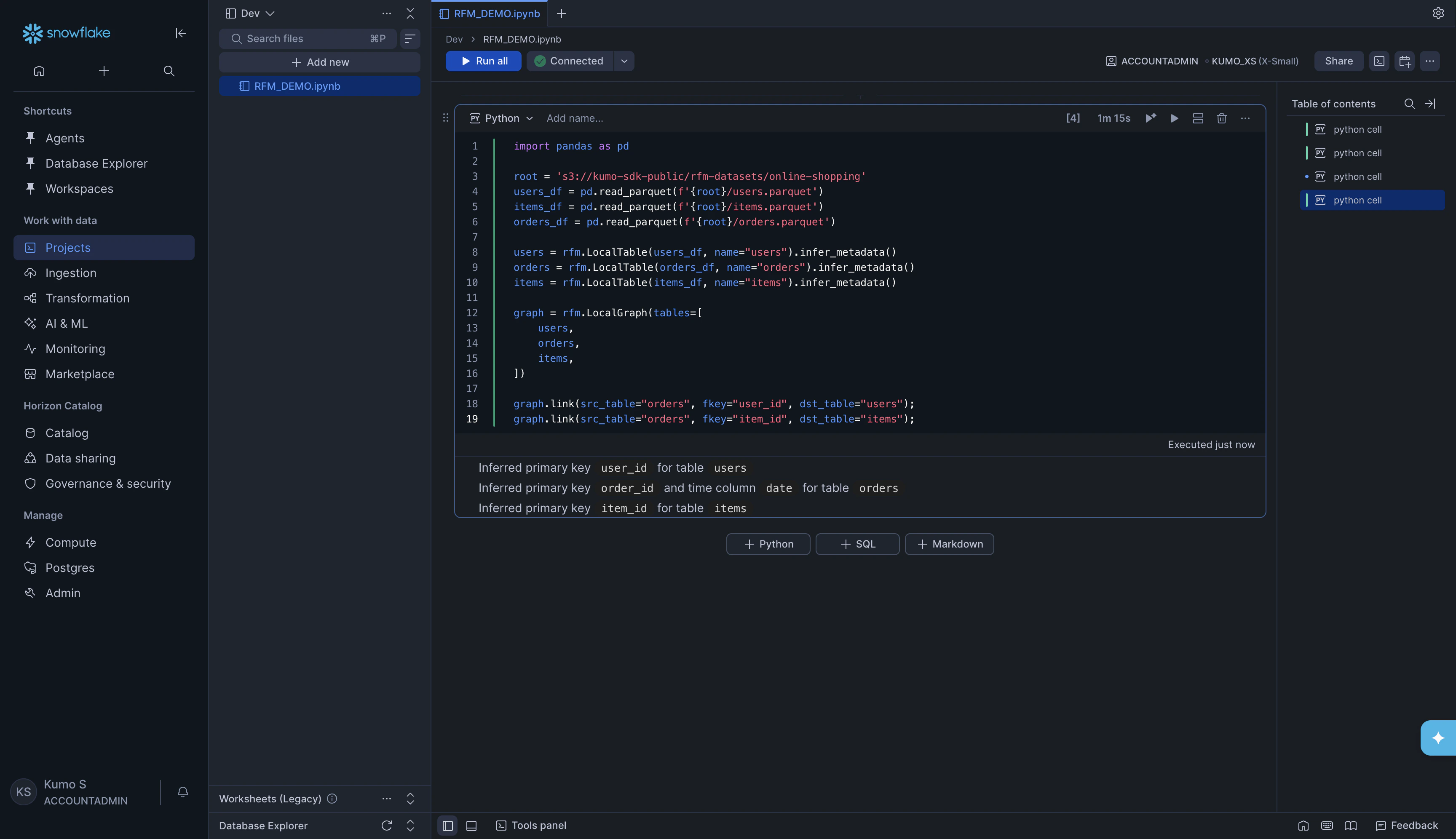
Load the data and create tables:
import pandas as pd

root = 's3://kumo-sdk-public/rfm-datasets/online-shopping'
users_df = pd.read_parquet(f'{root}/users.parquet')
items_df = pd.read_parquet(f'{root}/items.parquet')
orders_df = pd.read_parquet(f'{root}/orders.parquet')

users = rfm.LocalTable(users_df, name="users").infer_metadata()
orders = rfm.LocalTable(orders_df, name="orders").infer_metadata()
items = rfm.LocalTable(items_df, name="items").infer_metadata()

graph = rfm.Graph(tables=[
    users,
    orders,
    items,
])

graph.link(src_table="orders", fkey="user_id", dst_table="users");
graph.link(src_table="orders", fkey="item_id", dst_table="items");
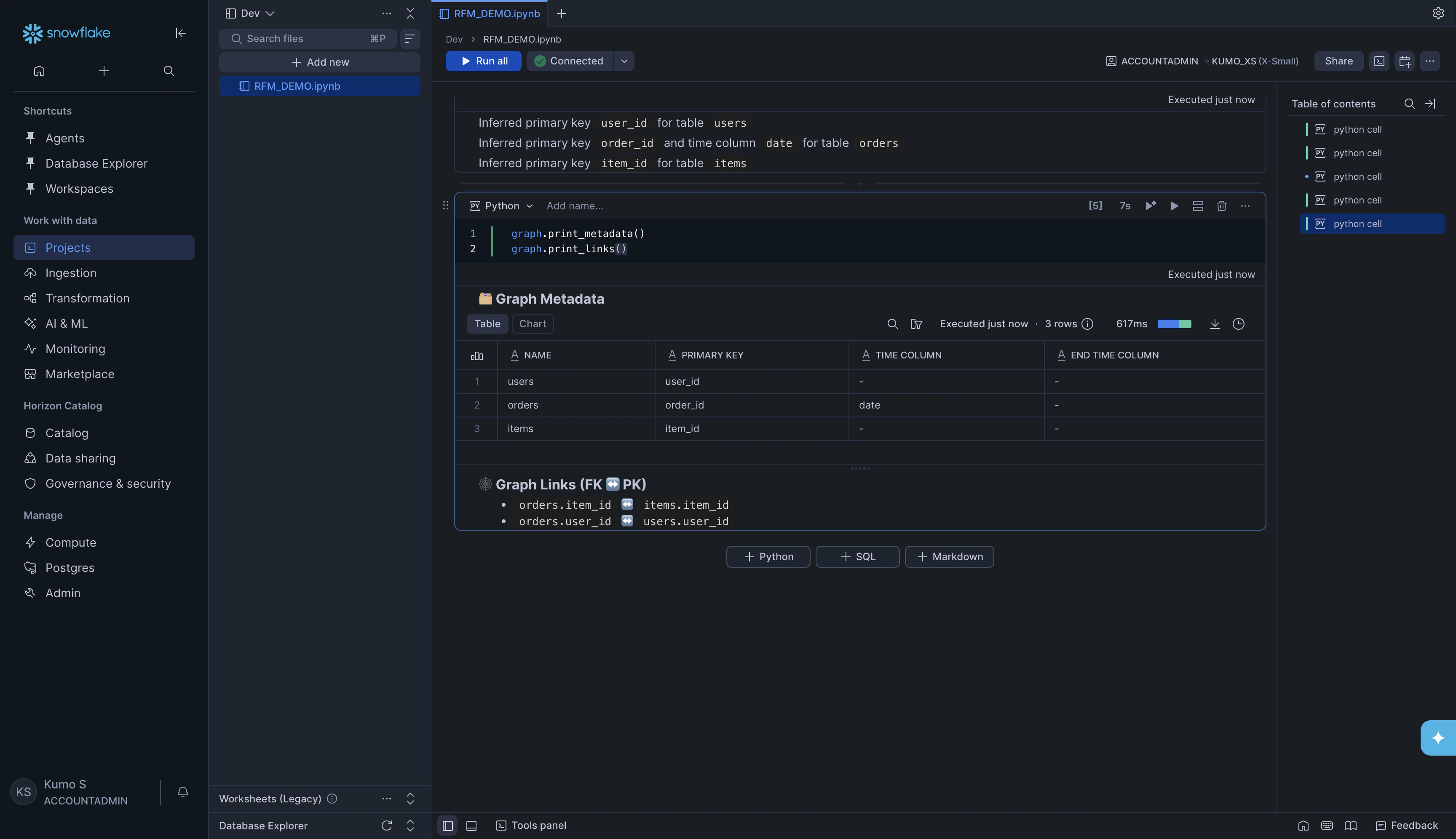
 Inspect the graph (optional but recommended):
graph.print_metadata()
graph.print_links()
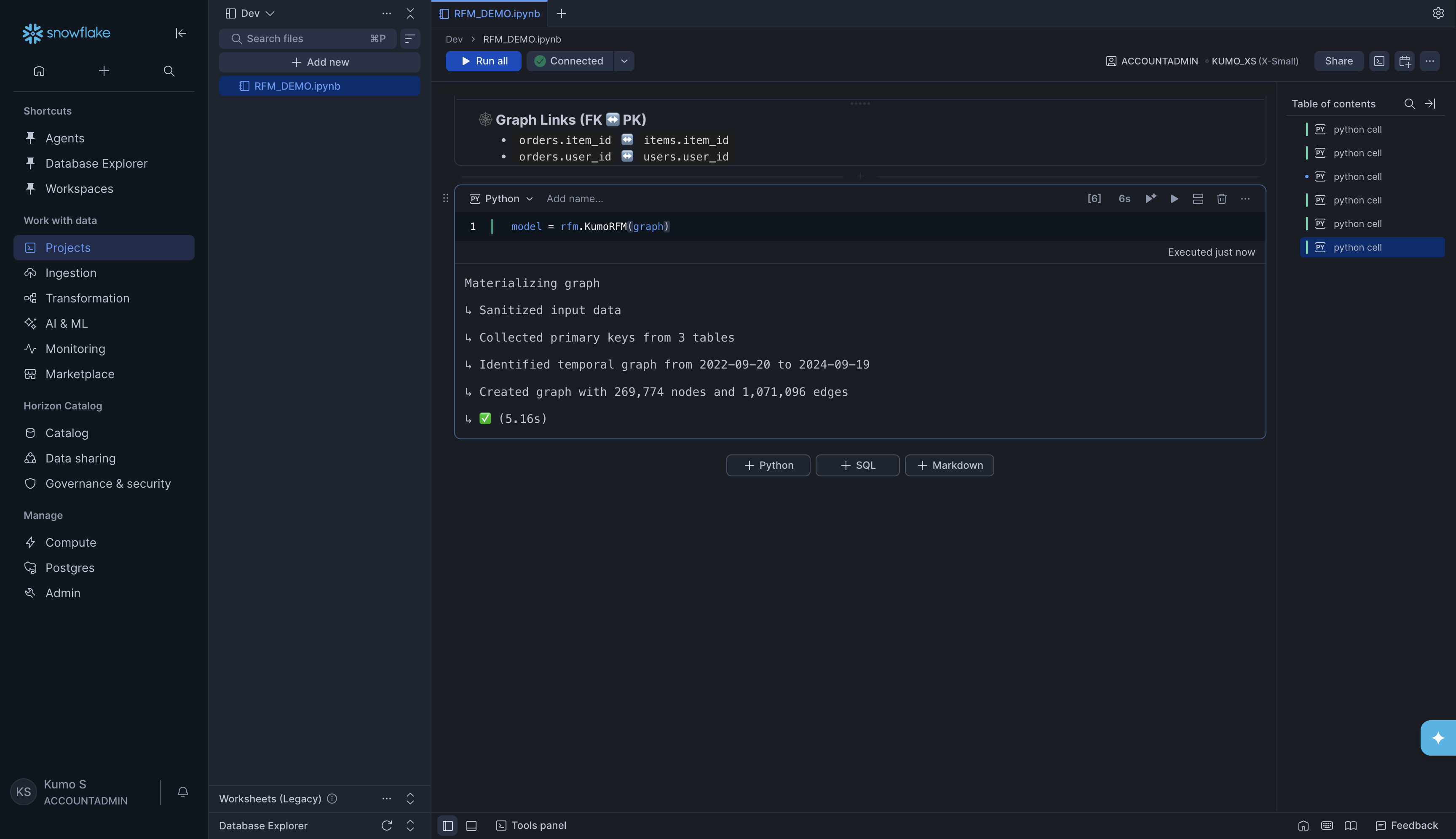
 Load the graph into KumoRFM:
model = rfm.KumoRFM(graph)
 Make a prediction:
Now you can write a Predictive Query (PQL) and get results. For example, to predict whether users 42 and 123 will make zero orders in the next 90 days (customer churn):
Make a prediction:
Now you can write a Predictive Query (PQL) and get results. For example, to predict whether users 42 and 123 will make zero orders in the next 90 days (customer churn):
query = "PREDICT COUNT(orders.*, 0, 90, days)=0 FOR users.user_id IN (42, 123)"

df = model.predict(query)
display(df)
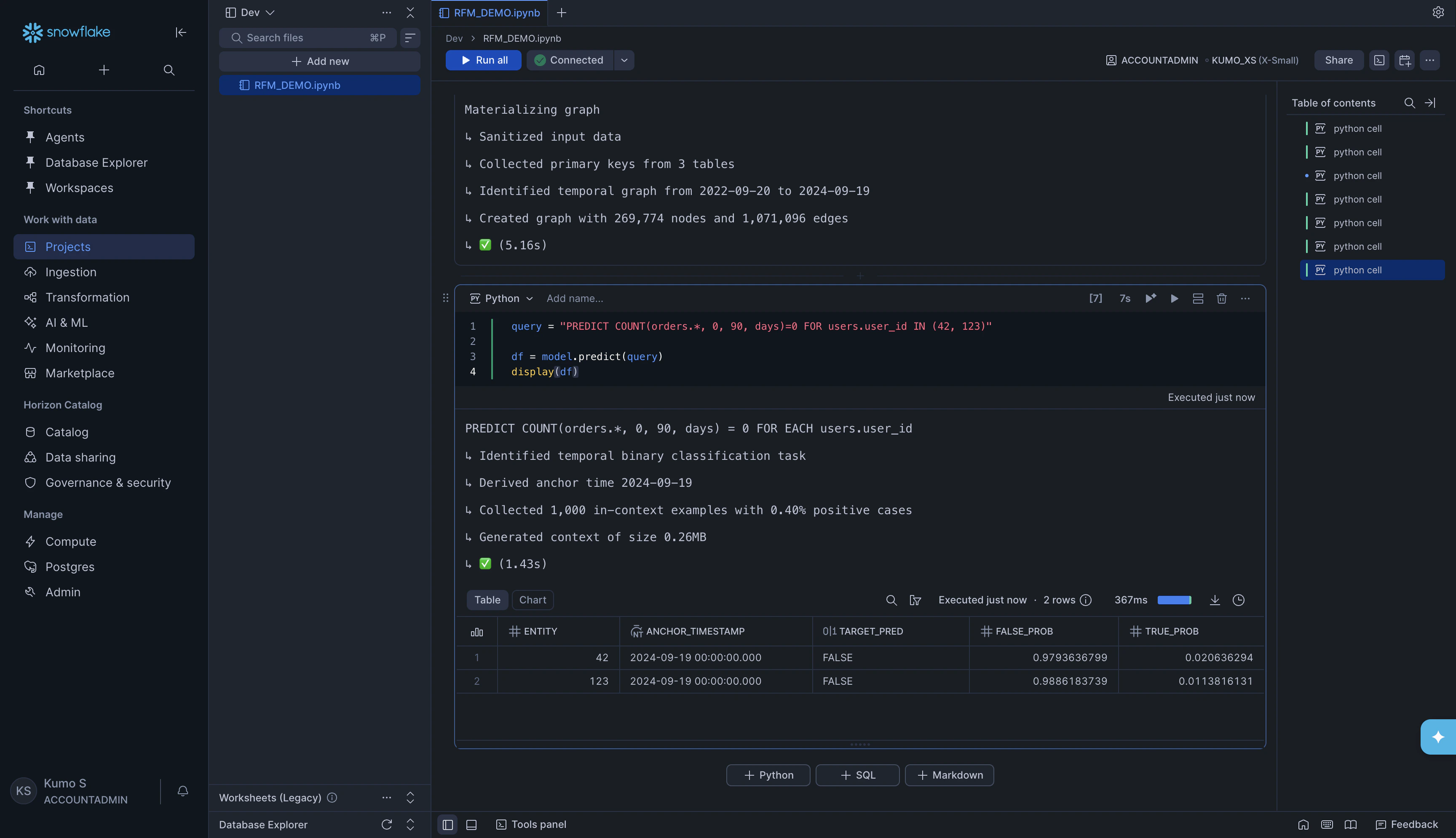 The result tells you:
- ENTITY - The user you predicted for
- ANCHOR_TIMESTAMP - The point in time the prediction is made from
- TARGET_PRED - The predicted class (
TRUE = will churn, FALSE = will not churn)
- FALSE_PROB / TRUE_PROB - The probability of each outcome
Option B: From a Snowflake Semantic View
If your organization has a Snowflake Semantic View set up, you can build a graph directly from it. The semantic view already contains table definitions and relationships, so KumoRFM reads everything automatically.
Set the database (if needed). Add a SQL cell and run:
USE DATABASE NL2PQL_TESTING_V0
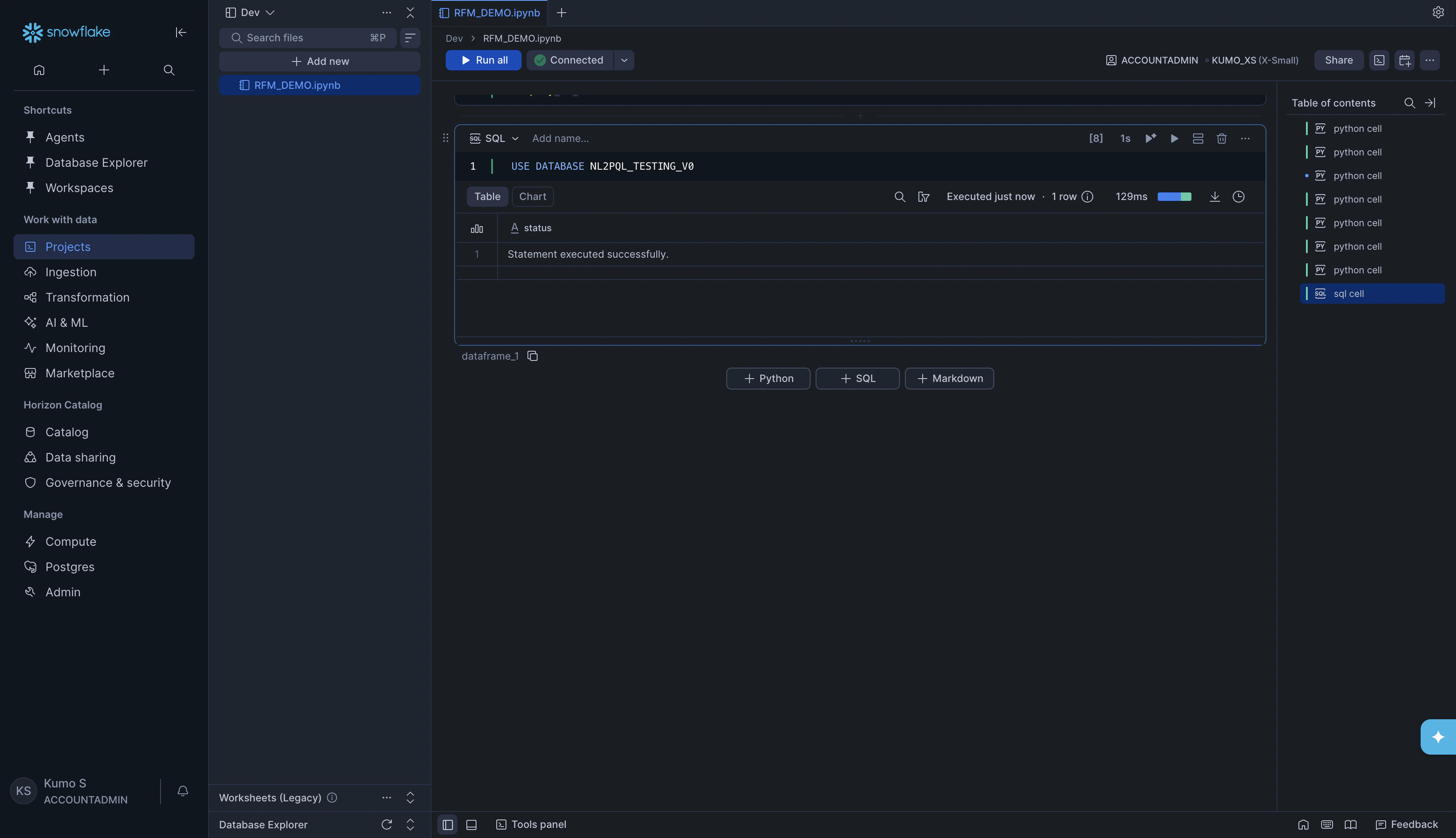
To add a SQL cell, click + SQL at the bottom of the notebook.
graph = rfm.Graph.from_snowflake_semantic_view(
    'CRM.CRM_SEMANTIC_VIEW',
    connection=connection,
)
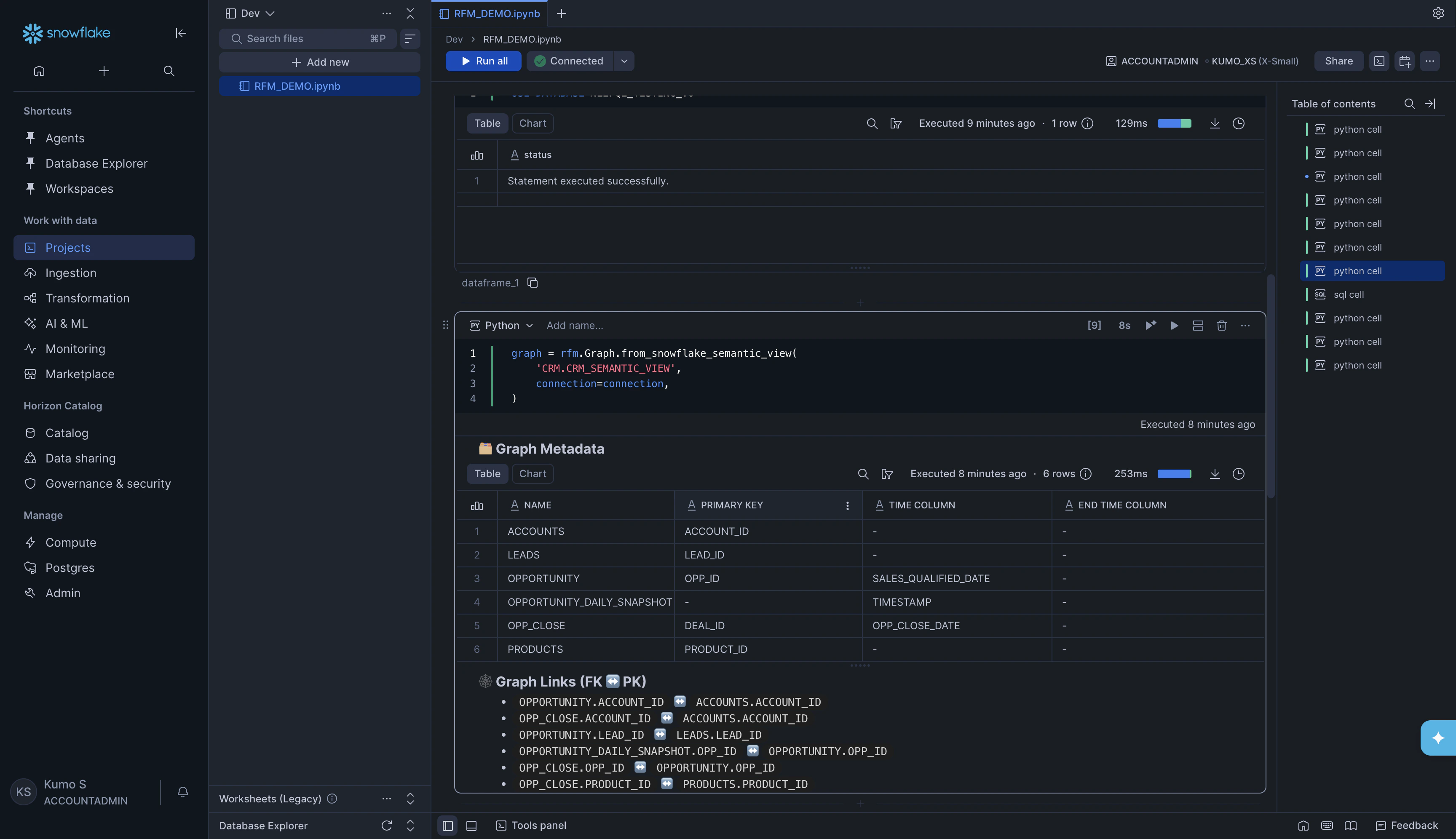 Load the graph and run a prediction:
model = rfm.KumoRFM(graph)
query = "PREDICT COUNT(OPP_CLOSE.*, 0, 7, days) FOR OPPORTUNITY.OPP_ID = 'o5'"

df = model.predict(query)
display(df)
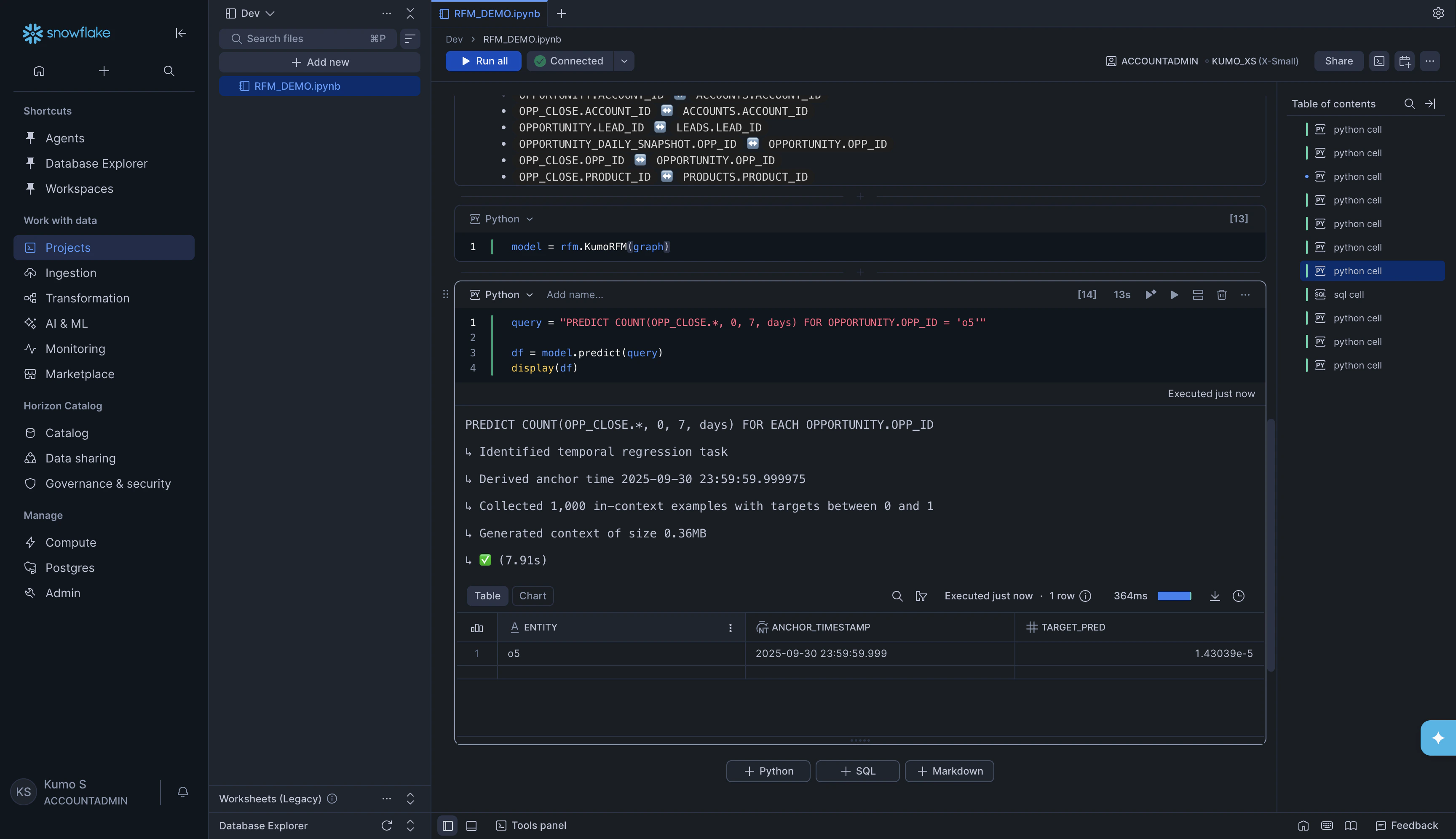
Option C: From Snowflake tables directly
For production use, you will typically point KumoRFM at your Snowflake tables directly. You create a SnowTable for each table, then combine them into a Graph.
Build the graph from Snowflake tables:
from kumoai.rfm.backend.snow import SnowTable

graph = rfm.Graph(
    tables=[
        SnowTable(connection=connection, name='ITEMS', database='NL2PQL_TESTING_V0', schema='ECOM'),
        SnowTable(connection=connection, name='ORDERS', database='NL2PQL_TESTING_V0', schema='ECOM'),
        SnowTable(connection=connection, name='RETURNS', database='NL2PQL_TESTING_V0', schema='ECOM'),
        SnowTable(connection=connection, name='USERS', database='NL2PQL_TESTING_V0', schema='ECOM'),
        SnowTable(connection=connection, name='VIEWS', database='NL2PQL_TESTING_V0', schema='ECOM'),
    ],
    edges=[],
)

graph.infer_metadata()
graph.infer_links()
database, schema, and table name values with your own. KumoRFM will detect primary keys, time columns, and foreign key relationships automatically.
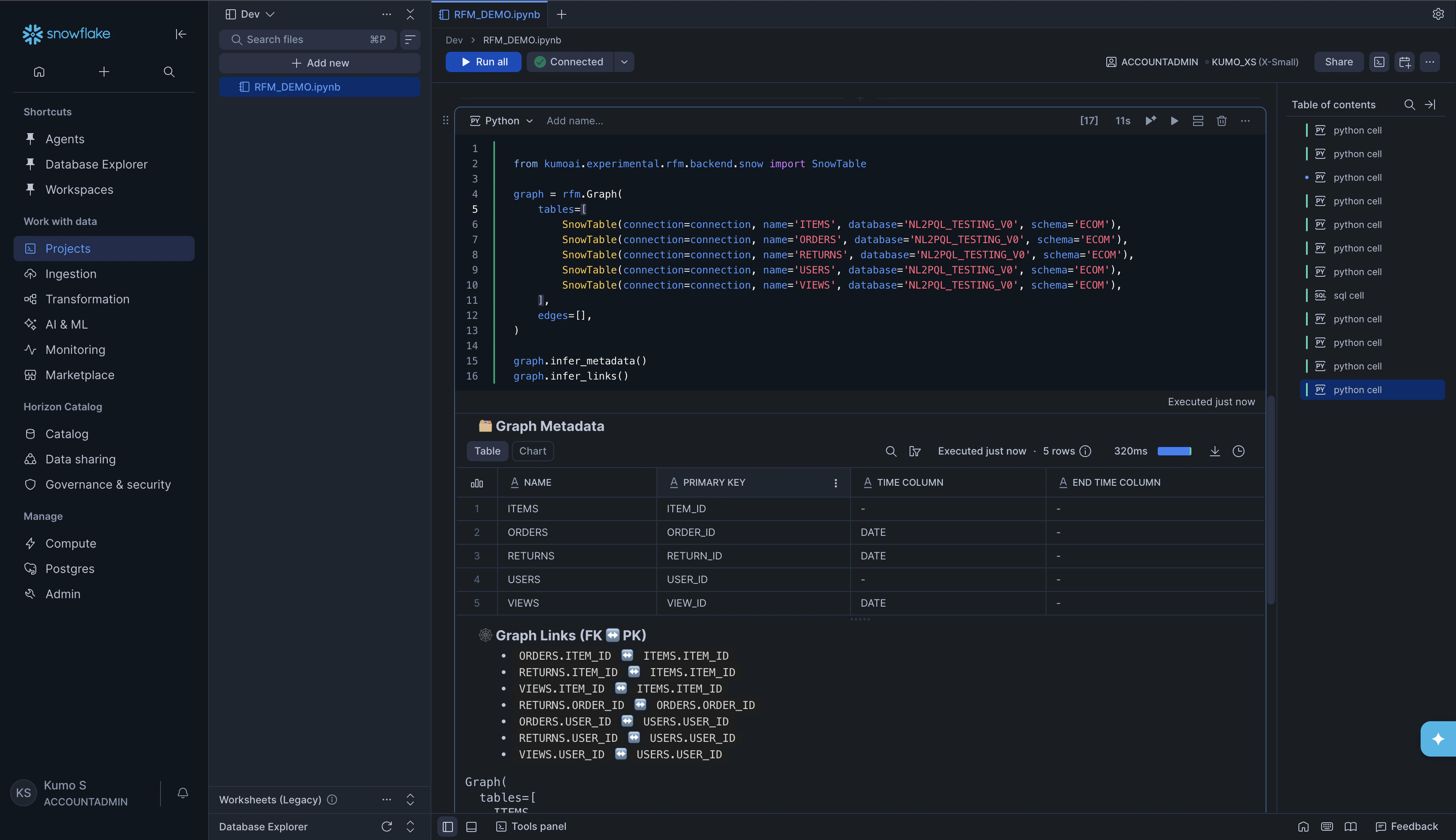 Load the graph and run a prediction:
model = rfm.KumoRFM(graph)
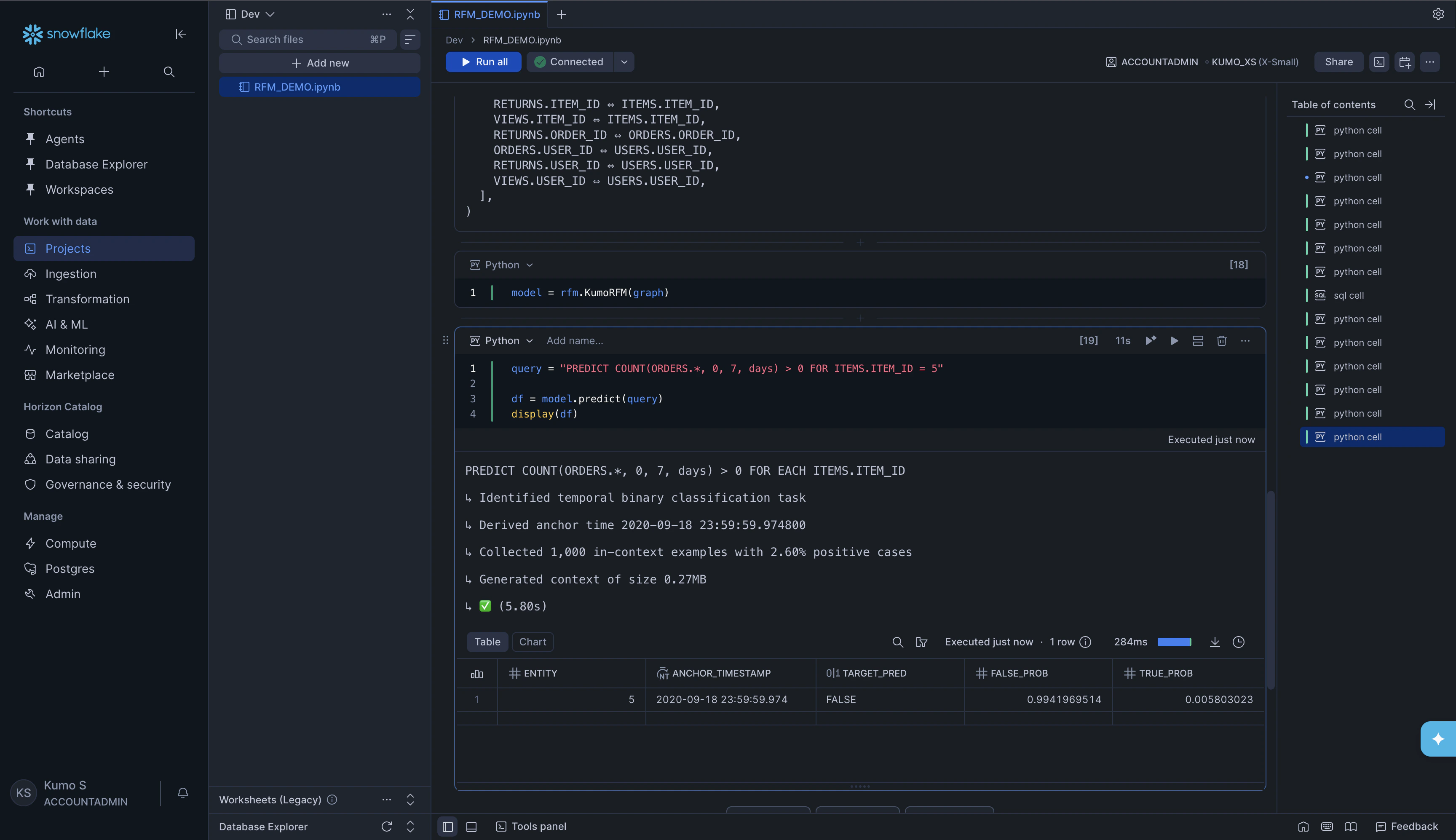
query = "PREDICT COUNT(ORDERS.*, 0, 7, days) > 0 FOR ITEMS.ITEM_ID = 5"

df = model.predict(query)
display(df)
Understanding the Prediction Output
Regardless of which option you used above, the prediction result is always a pandas DataFrame. The columns depend on the type of prediction:
| Column | Description |
|---|
ENTITY | The entity you predicted for (e.g., a user ID, item ID, or opportunity ID) |
ANCHOR_TIMESTAMP | The point in time the prediction is made from. By default, this is the latest timestamp in your data. |
TARGET_PRED | The predicted value or class |
FALSE_PROB / TRUE_PROB | For binary classification tasks only - the probability of each outcome |
What’s Next
