

Jupyter in PyCharm + Kumo Coding Agent
Overview
This guide walks you through setting up the KumoSDK and Kumo Coding Agent for use with the KumoRFM Pre-Trained model in Jupyter notebooks inside JetBrains PyCharm and IntelliJ development environments. This guide assumes minimal prior experience with Jupyter, PyCharm or IntelliJ editors, and coding agents. Experienced users may skip directly to the relevant sections.Prerequisites
Make sure you have:- PyCharm installed (Download) (or any python compatible IntelliJ editor)
- Python installed at the system level
- Access to a KumoRFM environment, including an API key and any required API URL
- Required PyCharm plugins enabled These plugins are usually installed and enabled by default, so you may not need to do anything. If needed, you can review, enable, or install plugins from PyCharm -> Settings -> Plugins.
- An OpenAI or Anthropic subscription (recommended - required for use with the Kumo Coding Agent)
- OpenAI Codex via JetBrains AI subscription, or OpenAI subscription
- Anthropic Claude Code via JetBrains AI subscription, or Claude subscription
- Homebrew (macOS package manager) (Install)
- GitHub CLI installed and authenticated (required for cloning coding agent context from GitHub)
🖥 Terminal
Part 1: Setup for Jupyter in PyCharm + KumoSDK
Step 1: Create or Open a PyCharm Project
To create a new notebook:- Create a new project
-
-
Select or create a local python environment for the project
- Project type: Pure Python or Jupyter
- Environment type:
Venv(recommended) orConda(if the Anaconda distribution is installed) - Select a Python version between 3.10 and 3.13
-
Select or create a local python environment for the project
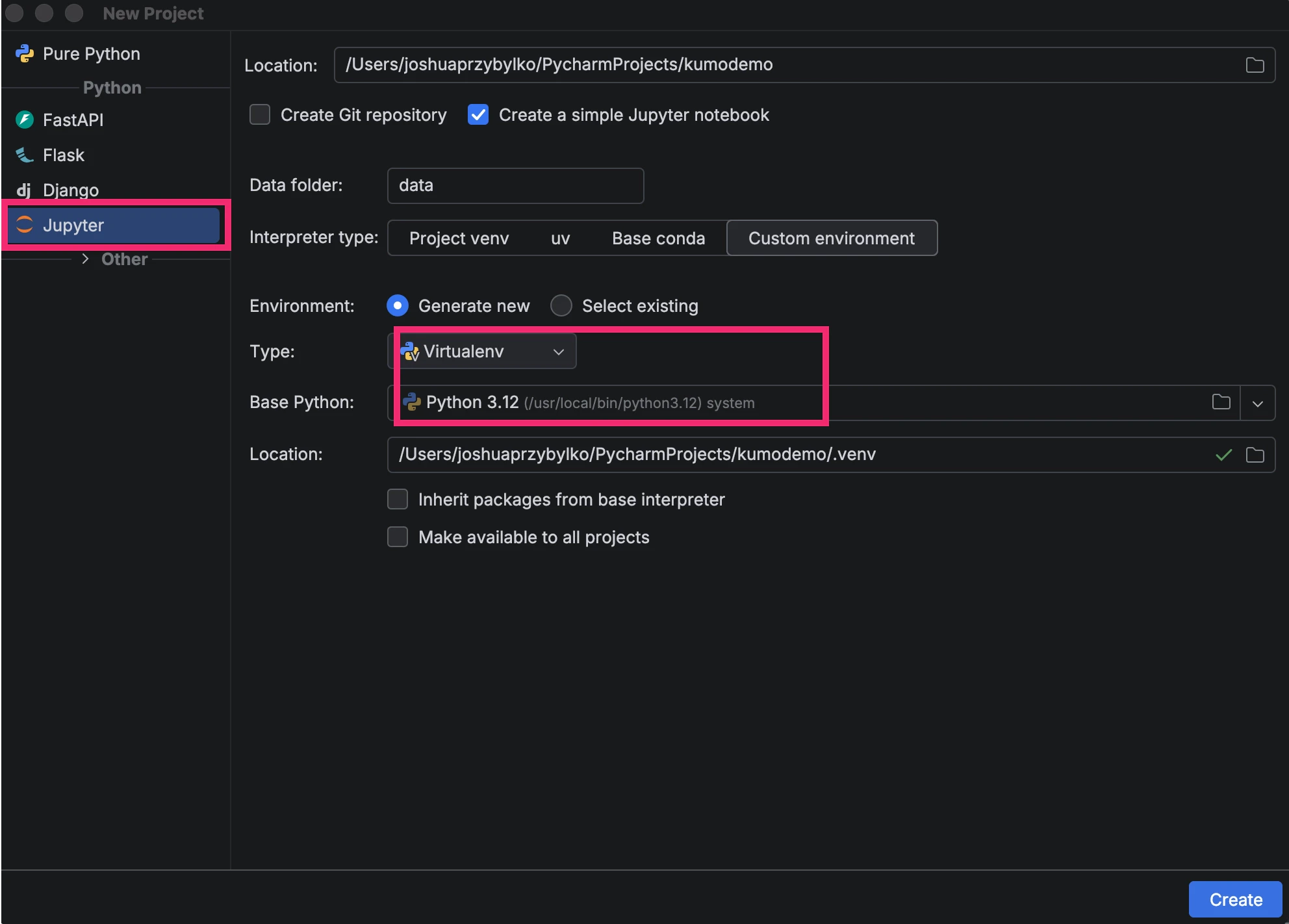
- Create a notebook
.ipynbfile inside your project - Run a Cell (e.g.,
print("Hello Kumo!")to Start the Jupyter Server and notebook kernel - Install or upgrade ipywidgets
📓 Notebook cell
Step 2: Install KumoSDK
Install the KumoSDK in the same notebook environment:📓 Notebook cell
📓 Notebook cell
Step 3: Authenticate KumoSDK
You will need an API key to make calls to KumoRFM. There are two common approaches:- Use the interactive code block below to set
KUMO_API_KEYfrom the notebook - Set
KUMO_API_KEYmanually with the API key provided for your KumoRFM environment
📓 Notebook cell
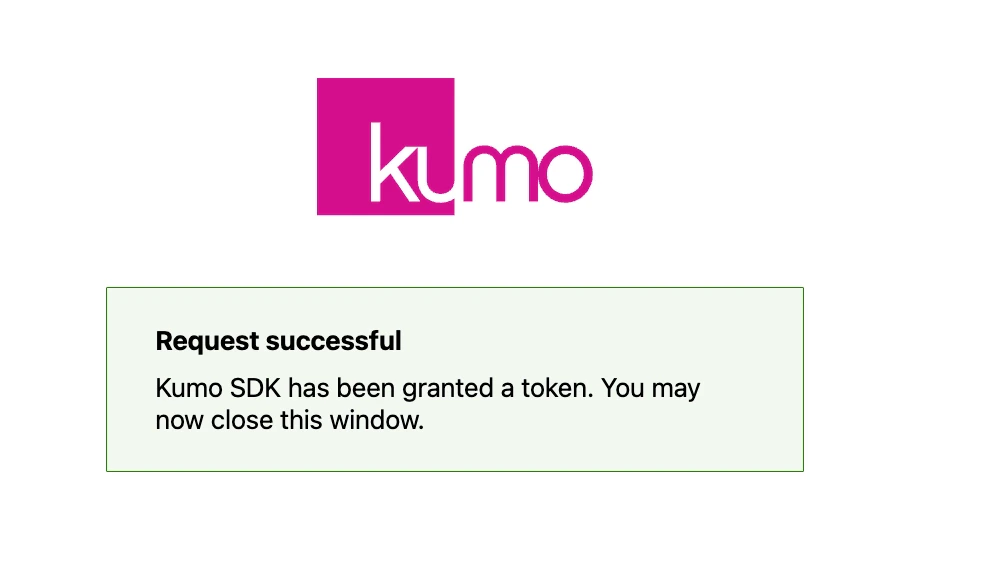
📓 Notebook cell
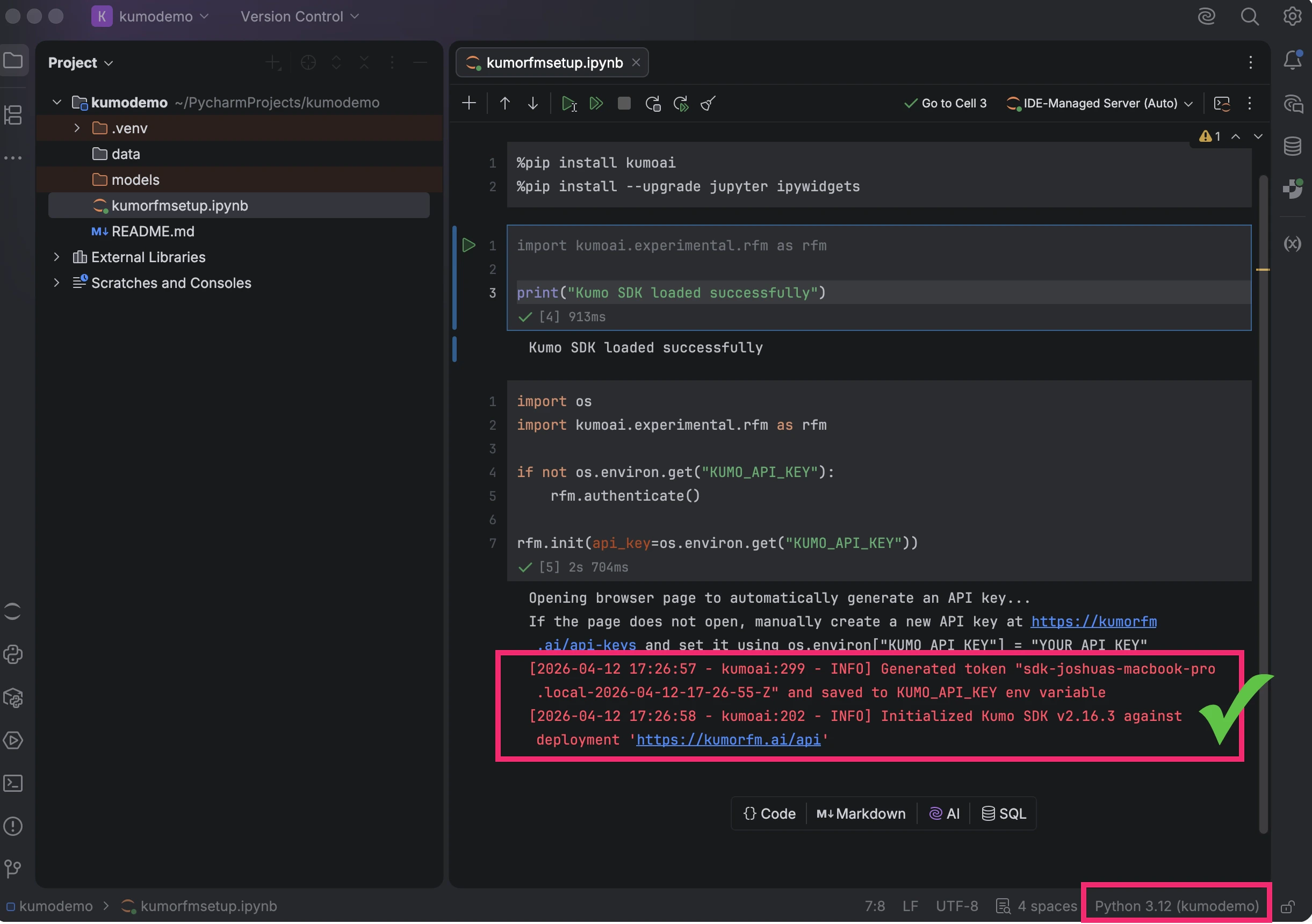
Step 4: Optional Dependencies
Install Graphviz:
The KumoSDK allows you to define and visualize a Kumo Graph, which represents data tables and the relationships between them. To enable Kumo Graph visualization with KumoSDK, the Graphviz library must be installed correctly. Installation requires:dot— an executable that is part of the Graphviz library, installed at the system level- The
graphvizPython package installed in the notebook kernel
dot is installed:
📓 Notebook cell
None, install Graphviz:
🖥 Terminal
📓 Notebook cell
📓 Notebook cell
Install Jinja2:
The KumoSDK requires Jinja2, a Python library used to style displayed outputs.📓 Notebook cell
Part 2: Add a Coding Agent (Optional)
Choose one of the following to add an AI coding agent to your workflow:- Flow A — OpenAI Codex
- Flow B — Anthropic Claude Code
Step 1: Open JetBrains AI and Select CodexJetBrains documents that Codex is available directly in JetBrains AI chat starting from IDE version This action adds a directory named To confirm the Kumo slash-command skills were installed correctly, list the available skills and look for:Step 3: Use the Kumo Coding AgentTry a real prediction:The agent will inspect the data, build a graph, and write PQL. You can then run the notebook end-to-end. If needed, authenticate the KumoSDK within the notebook before running the prediction.Step 4 (Optional): UpgradeUpgrade the KumoSDK:Upgrade the Kumo Coding Agent:To pin to a specific version:
2025.3. Make sure you are using a recent PyCharm version and the latest AI Assistant plugin (enabled by default).To get started:- Open the JetBrains AI widget in the top-right corner of PyCharm
- Follow the setup and authentication flow if JetBrains AI subscription or OpenAI subscription has not been enabled yet
-
Open the AI chat and choose Codex from the agent picker
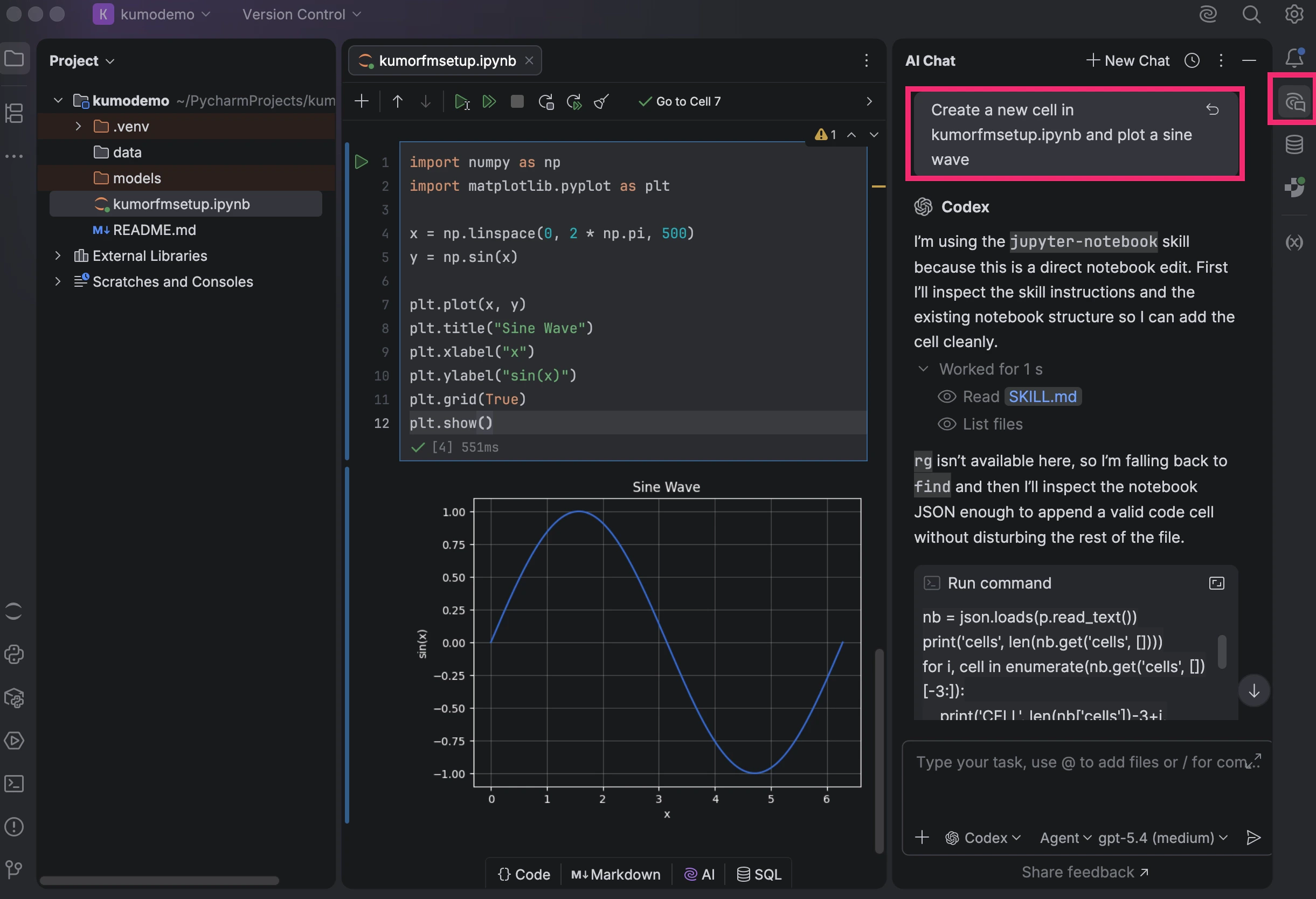
- Context (knowledge base): Documentation, PQL rules, workflow guides, and data connector references that teach the agent how to use the Kumo platform. Installed by cloning the repository.
- Skills (slash commands): Actions like
/kumo-issueand/kumo-prfor reporting bugs and contributing fixes. Installed via the skill installer.
🖥 Terminalkumo-coding-agent to your project. It contains the Kumo Coding Agent’s knowledge base. Confirm that this directory appears in your project.Codex reads AGENTS.md automatically. No extra configuration needed.Install the skills (optional).Inside a Codex session or chat interface, run the following command and approve the requested actions:🤖 Codex/kumo-issueto report an issue to Kumo/kumo-prto contribute fixes
🤖 Codex🤖 Codexwrap-code
Before asking Codex to modify the notebook, save your changes first. If the notebook is not saved, PyCharm may keep your unsaved version as the active notebook view and treat Codex’s edits as the previous file version. If you do not see Codex’s changes, try one of the following:
- Use the “Revert File” option in PyCharm to refresh the notebook (
Cmd + Shift + P->Revert File) - Close the notebook tab and reopen it
You are now fully set up with KumoSDK and the Kumo Coding Agent. You can proceed to:
- the Kumo
Coding Agent Quick Startfor coding agent examples - the Kumo
SDK Quick Startto get familiar with core SDK functionality
📓 Notebook cell🖥 TerminalTroubleshooting
- If the notebook opens but cells do not run, re-check the selected interpreter and whether the Jupyter server started successfully.
- If
%pip install kumoaisucceeds butimport kumoai.rfmfails, verify that the notebook is using the same interpreter where the package was installed. - If authentication fails, confirm
KUMO_API_KEYis set or repeatrfm.authenticate(). - If Codex is not available in PyCharm, verify your PyCharm version, the AI Assistant plugin version, and that Codex appears in the JetBrains AI agent picker.
- If Claude Code helps with project files but not notebook behavior, keep notebook execution inside PyCharm and use Claude Code mainly for project-side code and explanations.