

Jupyter in VS Code + Kumo Coding Agent
Overview
This guide walks you through setting up the KumoSDK and Kumo Coding Agent for use with the KumoRFM Pre-Trained model in Jupyter notebooks inside VS Code. This guide assumes minimal prior experience with Jupyter, VS Code, and coding agents. Experienced users may skip directly to relevant sections.Prerequisites
Make sure you have:- VS Code installed (Download)
- Python installed at the system level
- Access to a KumoRFM environment, including an API key and any required API URL
- VS Code Extensions
- Python (by Microsoft)
- Jupyter Extension Pack (by Microsoft)
- OpenAI or Anthropic subscription (recommended - required for use with Kumo Coding Agent)
- Homebrew (macOS package manager) (Install)
- GitHub CLI installed and authenticated (required for installing coding agent skills):
🖥 Terminal
Part 1: Setup for Jupyter in VS Code + KumoSDK
Step 1: Create or Open a Jupyter Notebook
To create a new notebook:- Open the Command Palette (
Cmd + Shift + P) - Search for
Create: New Jupyter Notebook - Save the notebook (e.g.,
kumo_notebook.ipynb)
- Environment type:
Venv(recommended) orConda(if the Anaconda distribution is installed) - Select a Python version between 3.10 and 3.13
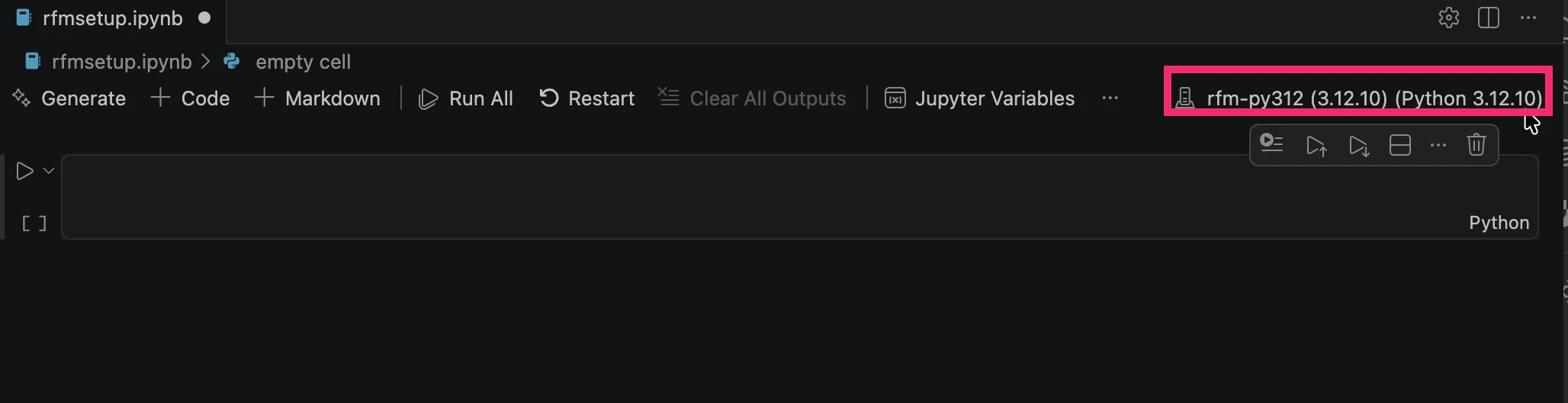
Step 2: Install KumoSDK
Install the KumoSDK inside the notebook kernel:📓 Notebook cell
📓 Notebook cell
Step 3: Authenticate KumoSDK
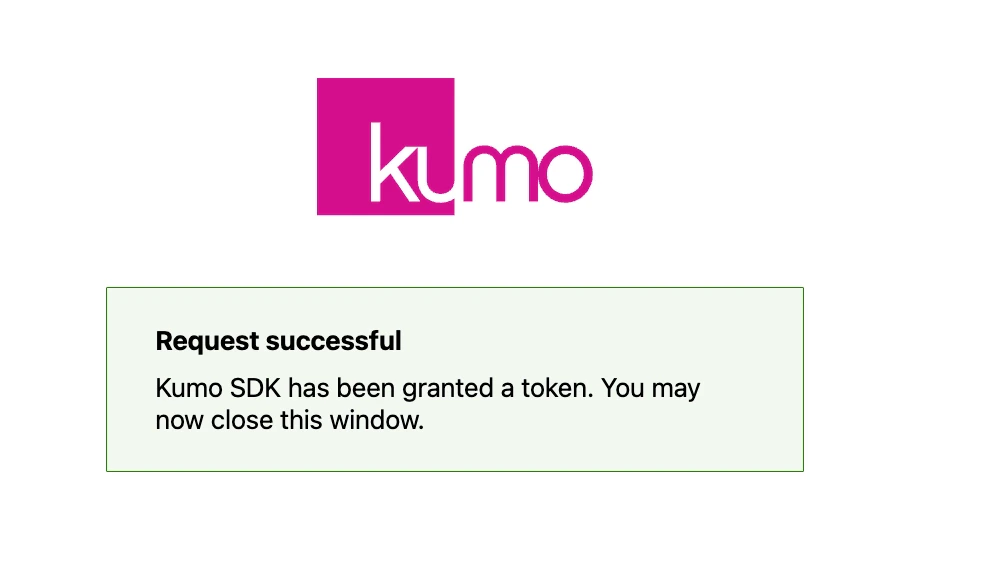
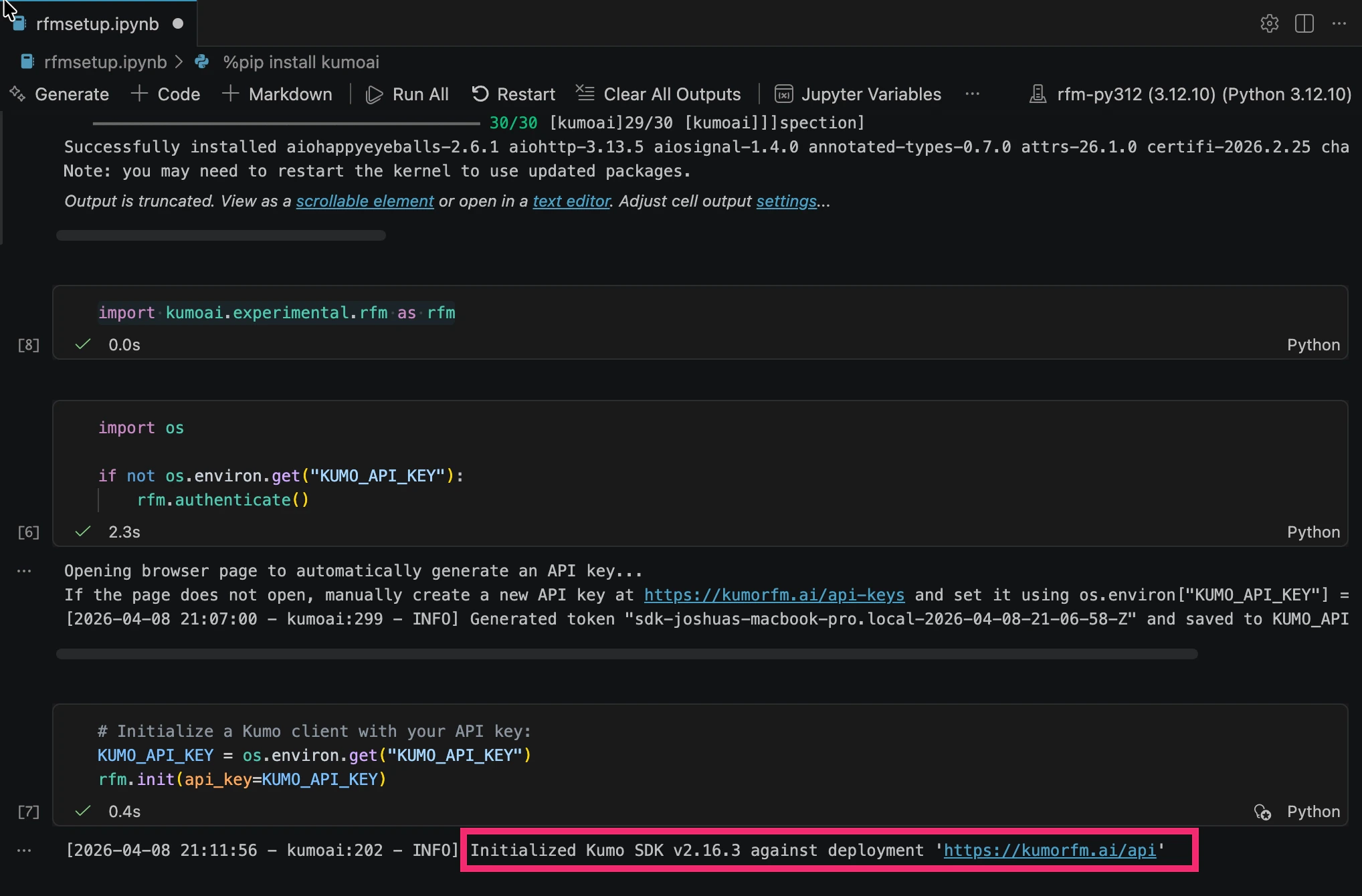
You will need an API key to make calls to KumoRFM. There are two common approaches:- Use the interactive code block below to set
KUMO_API_KEYfrom the notebook - Set
KUMO_API_KEYmanually with the API key provided for your KumoRFM environment
📓 Notebook cell
📓 Notebook cell
Step 4: Optional Dependencies
Install Graphviz:
The KumoSDK allows you to define and visualize a Kumo Graph, which represents data tables and the relationships between them. To enable Kumo Graph visualization with KumoSDK, the Graphviz library must be installed correctly. Installation requires:dot— an executable that is part of the Graphviz library, installed at the system level- The
graphvizPython package installed in the notebook kernel
dot is installed:
📓 Notebook cell
None, install Graphviz:
🖥 Terminal
📓 Notebook cell
📓 Notebook cell
Install Jinja2:
The KumoSDK requires Jinja2, a Python library used to style displayed outputs.📓 Notebook cell
Part 2: Add a Coding Agent (Optional)
Choose one of the following to add an AI coding agent to your workflow:- Flow A — OpenAI Codex
- Flow B — Anthropic Claude Code
Step 1: Install ExtensionIf the Jupyter Notebook skill is installed, you should see listed:To install the skill, run: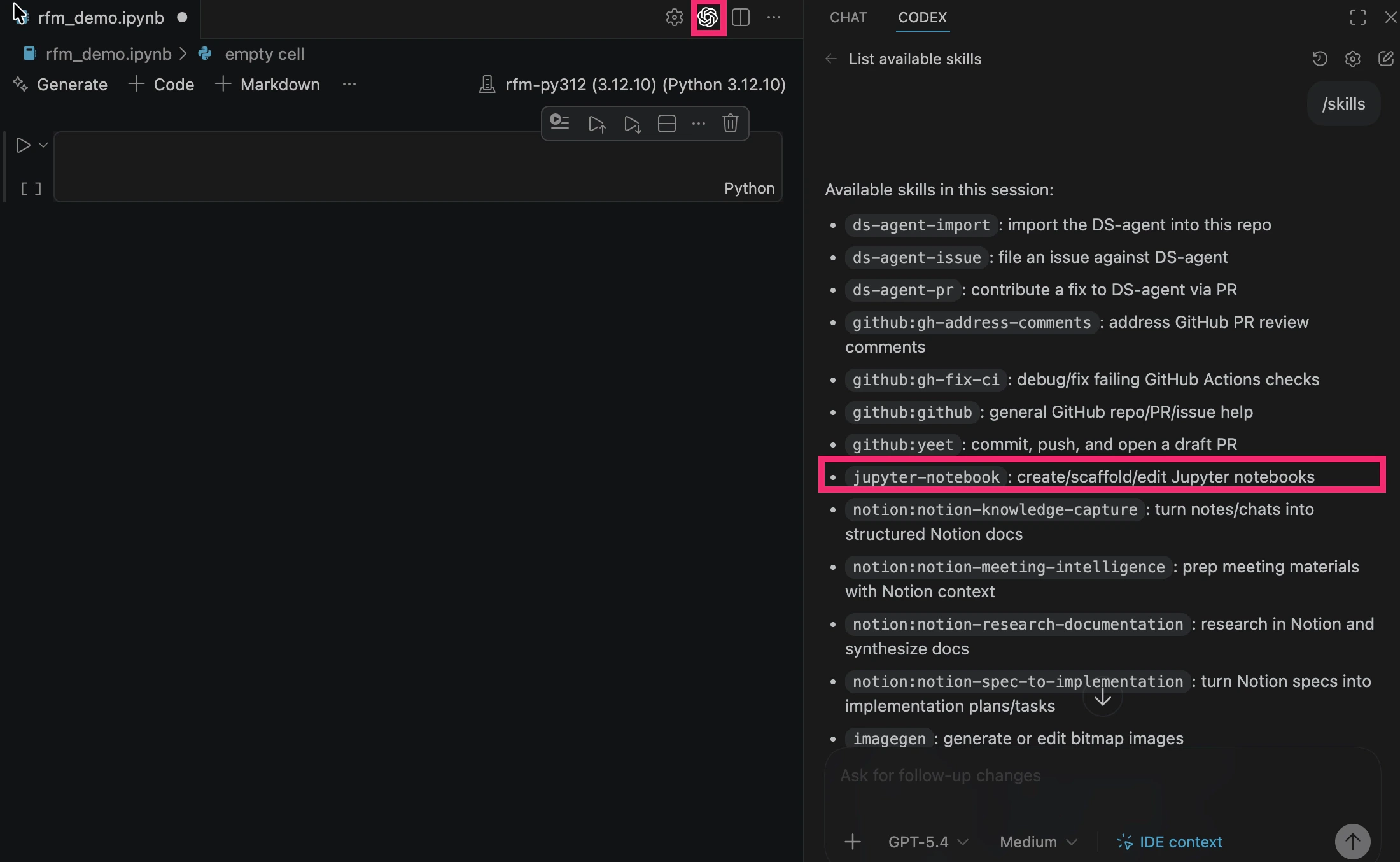
- Open VS Code Extensions (
Cmd + Shift + X) - Search for “Codex – OpenAI’s coding agent”
- Install the extension
- Sign in with ChatGPT (recommended)
- Or configure
~/.codex/config.toml
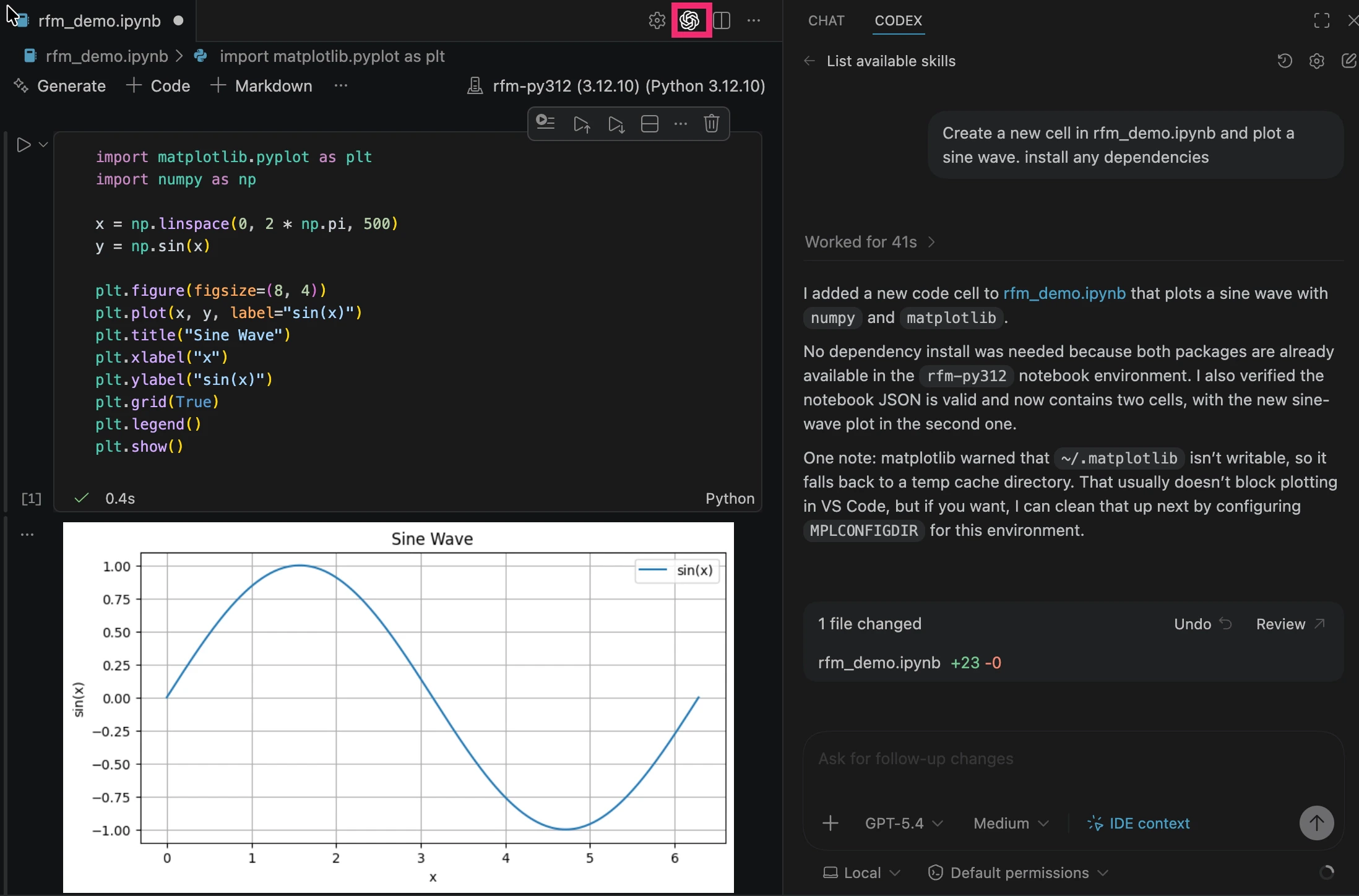
- The ChatGPT icon in the top-right corner added by the plugin
🤖 Codex🤖 Codexwrap-code
🤖 CodexThe Codex agent can now modify files and notebooks, but you must still execute notebook cells manually.
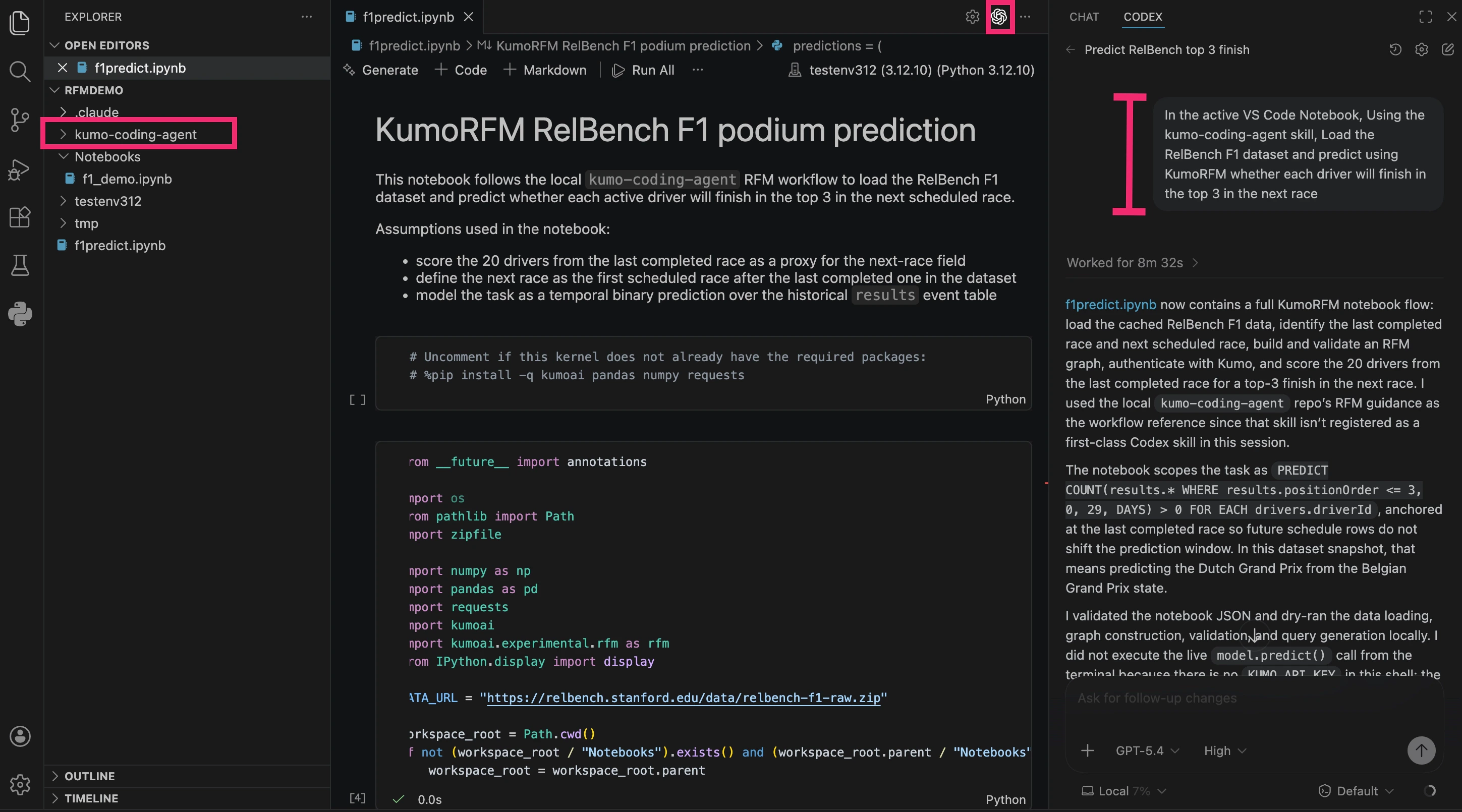
- Context (knowledge base): Documentation, PQL rules, workflow guides, and data connector references that teach the agent how to use the Kumo platform. Installed by cloning the repository.
- Skills (slash commands): Actions like
/kumo-issueand/kumo-prfor reporting bugs and contributing fixes. Installed via the skill installer.
🖥 Terminalkumo-coding-agent to your project. It contains the Kumo Coding Agent’s knowledge base. Confirm that this directory appears in your project.Codex reads AGENTS.md automatically. No extra configuration needed.Install the skills (optional). Inside a Codex session:🤖 Codex🤖 Codexwrap-code
Before asking Codex to modify the notebook, save your changes first. If the notebook is not saved, VS Code may keep your unsaved version as the active notebook view and treat Codex’s edits as the previous file version. If you do not see Codex’s changes, try one of the following:
- Use the “Revert File” option in VS Code to refresh the notebook (
Cmd + Shift + P->Revert File) - Close the notebook tab and reopen it
You are now fully set up with KumoSDK and the Kumo Coding Agent. You can proceed to:
- the Kumo
Coding Agent Quick Startfor coding agent examples - the Kumo
SDK Quick Startto get familiar with core SDK functionality
📓 Notebook cell🖥 Terminal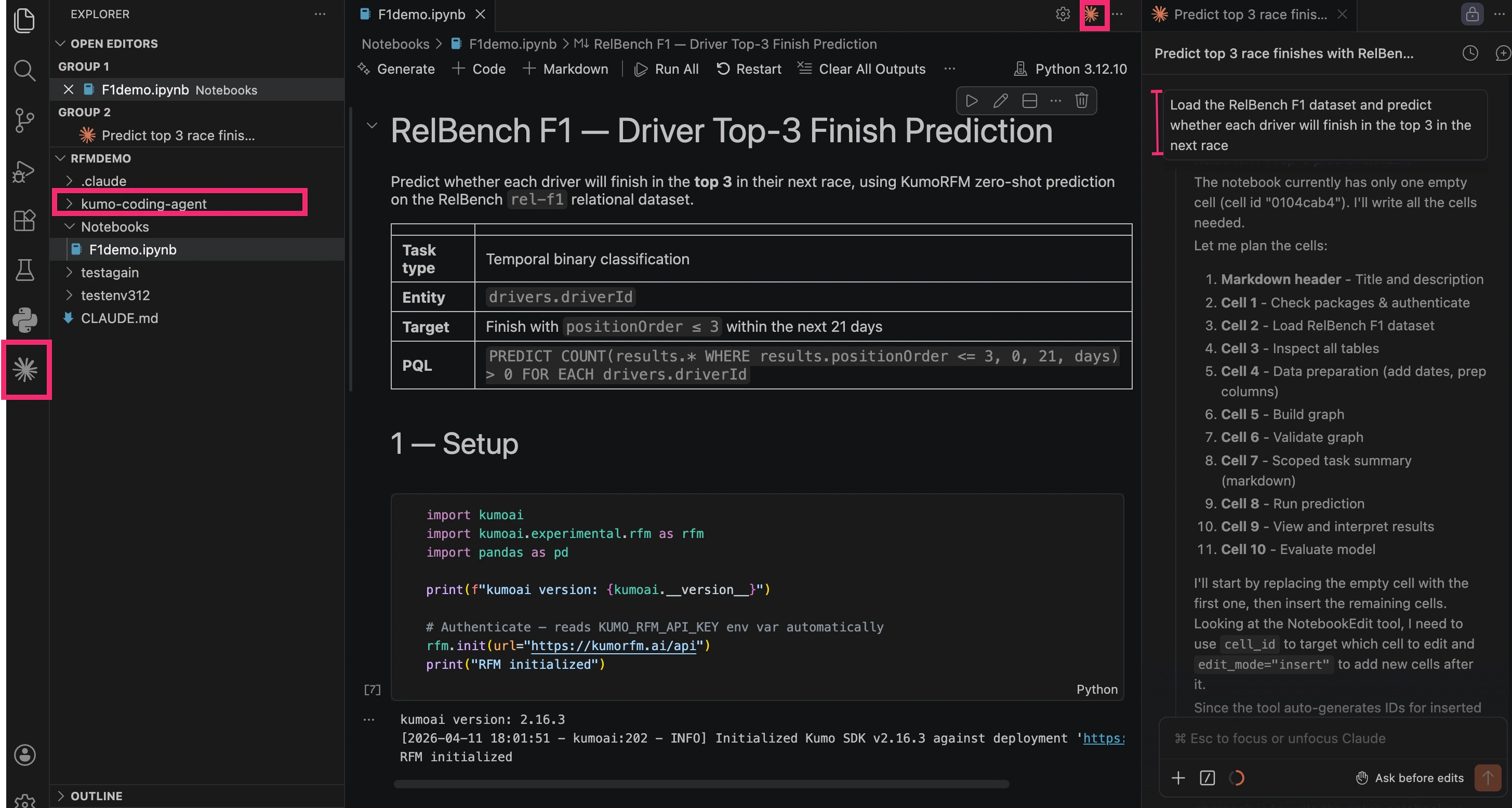
Troubleshooting
Notebook does not run
- Ensure the Jupyter extension is installed
- Ensure a kernel is selected
- Ensure Python version is 3.10–3.13
Kernel does not appear
- Restart VS Code
- Reopen the notebook
- Install
ipykernel
Wrong Python environment
- Re-select the kernel from Python Environments
kumoai cannot be imported
📓 Notebook cell
API key is missing
📓 Notebook cell
Next Steps
- Setup for SDK fundamentals
- Make Predictions for PQL query reference
- Kumo Coding Agent for agent source and skills