> ## Documentation Index
> Fetch the complete documentation index at: https://kumo.ai/docs/llms.txt
> Use this file to discover all available pages before exploring further.
# Static vs. Temporal
Predictive Queries are mainly used to generate a training table that gets attached to an underlying graph.
**Static queries** that don't involve making predictions over some window of time do not require a time column in the target table(s); in these cases, by default, Kumo generates training/validation/holdout splits by randomly distributing the rows according to an **80/10/10** ratio. While the time column is not required, it is allowed, and you may also distribute the rows according to a specific time range.
**Example: Predicting Transaction Fraud**
The following Predictive Query predicts **the fraud label that's directly attached to each transaction**:
```Text PQL theme={null}
PREDICT TRANSACTIONS.LABEL
FOR EACH TRANSACTIONS.TRANSACTION_ID
```
In contrast, **temporal queries**, which predict some aggregation of values over time (e.g., *"purchases each customer will make over the next 7 days"*), are more complex. Data splits need to be **non-overlapping, properly ordered, and well-balanced** in size to prevent **data leakage** that could invalidate the predictions. Kumo **automatically** handles this by splitting the data into **training/validation/holdout** splits based on the time column in your target table.
For more information about how to specify the Split you would like to use, refer to the documentation [here](/reference/split).
**Example: Predicting Customer Purchases Over 30 Days**
The following Predictive Query predicts **customers who will refrain from making a purchase over the next 30 days**:
```Text PQL theme={null}
PREDICT COUNT(TRANSACTIONS.*, 0, 30, days) = 0
FOR EACH CUSTOMERS.CUSTOMER_ID
```
To generate training examples, Kumo **travels back in time** and **"replays"** user behavior at different past time points, sampling data appropriately. It then **automatically** determines the best sampling and training split methodology based on your dataset and Predictive Query, as depicted below:
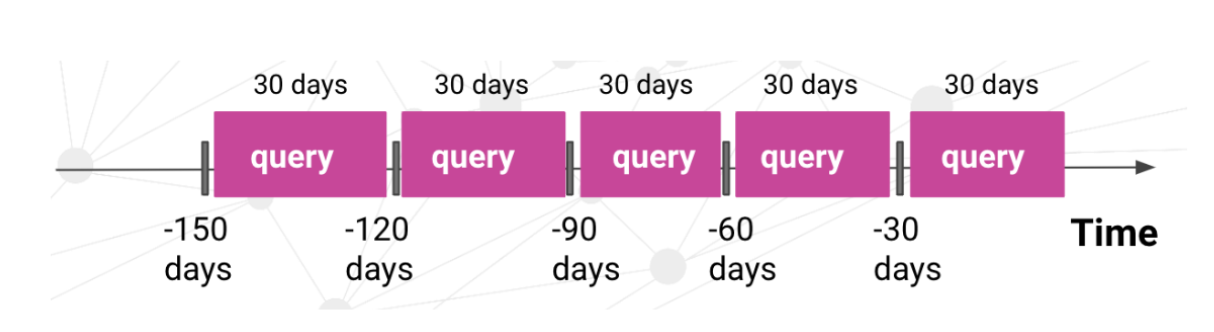 Kumo **analyzes your Predictive Query and dataset** to determine the **optimal sampling rates and splits**. For **temporal queries**, Kumo ensures:
* The **holdout split occurs strictly later in time** than the training split.
* The **training splits are balanced** in size.
This process ensures **optimal model performance** and eliminates errors from manual training split setup.
***
**Example: Predicting Total Sales Over 30 Days**
The following Predictive Query predicts the **total sales value per customer in the next 30 days**:
```Text PQL theme={null}
PREDICT SUM(TRANSACTIONS.PRICE, 0, 30, days)
FOR EACH CUSTOMERS.CUSTOMER_ID
```
For this query, Kumo generates **training/validation/holdout splits** based on the time range of the `transactions` table.
For example, if your dataset spans **September 20, 2018, to September 22, 2020**, Kumo will:
* Compute 30-day user spend at various past time points.
* Automatically generate the appropriate sampling and training split methodology.
This ensures that **training examples are correctly distributed** across the entire dataset while maintaining time-based integrity.
Kumo **analyzes your Predictive Query and dataset** to determine the **optimal sampling rates and splits**. For **temporal queries**, Kumo ensures:
* The **holdout split occurs strictly later in time** than the training split.
* The **training splits are balanced** in size.
This process ensures **optimal model performance** and eliminates errors from manual training split setup.
***
**Example: Predicting Total Sales Over 30 Days**
The following Predictive Query predicts the **total sales value per customer in the next 30 days**:
```Text PQL theme={null}
PREDICT SUM(TRANSACTIONS.PRICE, 0, 30, days)
FOR EACH CUSTOMERS.CUSTOMER_ID
```
For this query, Kumo generates **training/validation/holdout splits** based on the time range of the `transactions` table.
For example, if your dataset spans **September 20, 2018, to September 22, 2020**, Kumo will:
* Compute 30-day user spend at various past time points.
* Automatically generate the appropriate sampling and training split methodology.
This ensures that **training examples are correctly distributed** across the entire dataset while maintaining time-based integrity.