> ## Documentation Index
> Fetch the complete documentation index at: https://kumo.ai/docs/llms.txt
> Use this file to discover all available pages before exploring further.
# Querying RFM
> Deep-dive into PQL: Target×Entity×Horizon framework, entity specification, and example queries
**Predictive Query Language** (PQL) is a declarative query language that lets you define predictive problems on relational data. PQL specifies:
1. The **target** — what you want to predict (an aggregation or column value)
2. The **entity** — which rows/IDs to predict for
3. The **horizon** — the future time window to predict over (for temporal tasks)
For a thorough introduction to predictive queries, please refer to [the predictive query tutorial](https://docs.kumo.ai/docs/tutorial).
`KumoRFM` is currently in experimental phase. Some PQL features are not fully supported yet.
## Target x Entity x Horizon
The core framework for every KumoRFM prediction is **Target x Entity x Horizon**:
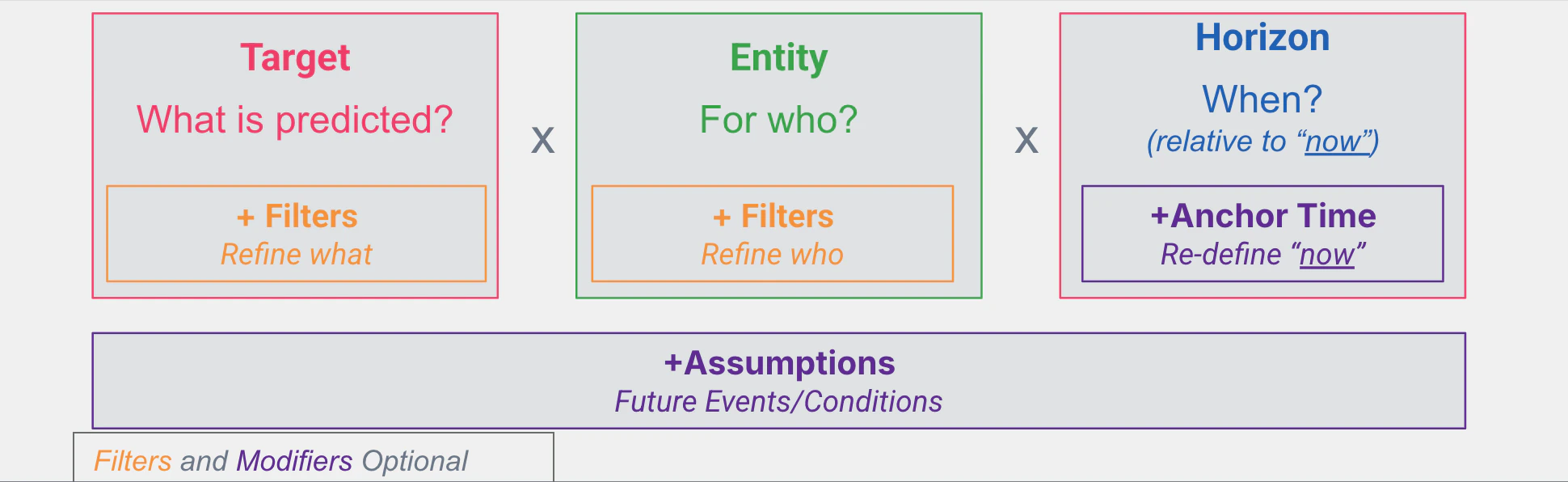 * **Target**: The value to predict — either an aggregation over related rows (*e.g.*, `COUNT(orders.*, 0, 30, days)`) or a static column value (*e.g.*, `users.age`).
* **Entity**: The specific row(s) to predict for, identified by a table's primary key (*e.g.*, `users.user_id=1`).
* **Horizon**: For temporal predictions, the future time window (*e.g.*, `0, 30, days` means "the next 30 days from now").
## PQL Structure
The general PQL structure is:
```sql theme={null}
PREDICT FOR WHERE
```
| Component | Purpose |
| ----------------------------- | -------------------------------------------------------- |
| `PREDICT ` | Declares the value or aggregate the model should predict |
| `FOR ` | Specifies the single ID or list of IDs to predict for |
| `WHERE ` (optional) | Filters which historical rows are used as context |
## Five Steps to Write a PQL Query
1. **Choose your entity** — pick a table and its primary key to predict for.
2. **Define the target** — a raw column or an aggregation over a future window.
3. **Pin the entity list** — pass a single ID or multiple IDs.
4. **(Optional) Refine the context** — add filters to restrict which historical rows are used for feature generation.
5. **Run & fetch** — call `KumoRFM.predict()` or `KumoRFM.evaluate()`.
## Entity Specification
Unlike the fine-tuning mode, KumoRFM makes predictions for a handful of selected entities at a time. Entities can be specified in three ways:
* **Single ID**: `users.user_id=1`
* **Tuple of IDs**: `users.user_id IN (1, 2, 3)`
* **Programmatic list** via the `indices` parameter:
```python theme={null}
result = model.predict(
"PREDICT COUNT(orders.*, 0, 30, days) > 0 FOR users.user_id=1",
indices=[1, 2, 3, 4, 5],
)
```
## Example Queries
**Temporal regression** — predict total spend in the next 30 days:
```sql theme={null}
PREDICT SUM(orders.price, 0, 30, days) FOR users.user_id=42
```
**Binary classification** — will a user churn (no orders in 90 days)?
```sql theme={null}
PREDICT COUNT(orders.*, 0, 90, days) = 0 FOR users.user_id=42
```
**Static prediction** — predict a user's age from relational context:
```sql theme={null}
PREDICT users.age FOR users.user_id=42
```
**Multi-horizon forecasting** — predict weekly revenue over 8 weeks:
```sql theme={null}
PREDICT SUM(orders.price, 0, 7, days) FORECAST 8 TIMEFRAMES FOR items.item_id=42
```
See `prediction_types` for a complete reference of all supported task types.
## Unsupported Features
Due to the experimental nature of `KumoRFM`, some PQL features are not yet fully supported:
* `LIST_DISTINCT()` without a time interval is not supported.
* Filtering by column value (*e.g.*, `WHERE users.age > 21`) is only supported for columns within the same table.
* Predicting a single non-aggregated value (*e.g.*, `PREDICT users.age`) only works for columns within the entity table.
## Further Reading
* `prediction_types` — all supported task types with PQL examples
* `filters_and_operators` — WHERE, IN, logical operators, anchor time
* `evaluation` — automatic evaluation and metrics
* `configuration` — run modes, explainability, batch mode, retry
* **Target**: The value to predict — either an aggregation over related rows (*e.g.*, `COUNT(orders.*, 0, 30, days)`) or a static column value (*e.g.*, `users.age`).
* **Entity**: The specific row(s) to predict for, identified by a table's primary key (*e.g.*, `users.user_id=1`).
* **Horizon**: For temporal predictions, the future time window (*e.g.*, `0, 30, days` means "the next 30 days from now").
## PQL Structure
The general PQL structure is:
```sql theme={null}
PREDICT FOR WHERE
```
| Component | Purpose |
| ----------------------------- | -------------------------------------------------------- |
| `PREDICT ` | Declares the value or aggregate the model should predict |
| `FOR ` | Specifies the single ID or list of IDs to predict for |
| `WHERE ` (optional) | Filters which historical rows are used as context |
## Five Steps to Write a PQL Query
1. **Choose your entity** — pick a table and its primary key to predict for.
2. **Define the target** — a raw column or an aggregation over a future window.
3. **Pin the entity list** — pass a single ID or multiple IDs.
4. **(Optional) Refine the context** — add filters to restrict which historical rows are used for feature generation.
5. **Run & fetch** — call `KumoRFM.predict()` or `KumoRFM.evaluate()`.
## Entity Specification
Unlike the fine-tuning mode, KumoRFM makes predictions for a handful of selected entities at a time. Entities can be specified in three ways:
* **Single ID**: `users.user_id=1`
* **Tuple of IDs**: `users.user_id IN (1, 2, 3)`
* **Programmatic list** via the `indices` parameter:
```python theme={null}
result = model.predict(
"PREDICT COUNT(orders.*, 0, 30, days) > 0 FOR users.user_id=1",
indices=[1, 2, 3, 4, 5],
)
```
## Example Queries
**Temporal regression** — predict total spend in the next 30 days:
```sql theme={null}
PREDICT SUM(orders.price, 0, 30, days) FOR users.user_id=42
```
**Binary classification** — will a user churn (no orders in 90 days)?
```sql theme={null}
PREDICT COUNT(orders.*, 0, 90, days) = 0 FOR users.user_id=42
```
**Static prediction** — predict a user's age from relational context:
```sql theme={null}
PREDICT users.age FOR users.user_id=42
```
**Multi-horizon forecasting** — predict weekly revenue over 8 weeks:
```sql theme={null}
PREDICT SUM(orders.price, 0, 7, days) FORECAST 8 TIMEFRAMES FOR items.item_id=42
```
See `prediction_types` for a complete reference of all supported task types.
## Unsupported Features
Due to the experimental nature of `KumoRFM`, some PQL features are not yet fully supported:
* `LIST_DISTINCT()` without a time interval is not supported.
* Filtering by column value (*e.g.*, `WHERE users.age > 21`) is only supported for columns within the same table.
* Predicting a single non-aggregated value (*e.g.*, `PREDICT users.age`) only works for columns within the entity table.
## Further Reading
* `prediction_types` — all supported task types with PQL examples
* `filters_and_operators` — WHERE, IN, logical operators, anchor time
* `evaluation` — automatic evaluation and metrics
* `configuration` — run modes, explainability, batch mode, retry